
The currency plunged!
People are getting out.
This month, Brazil returned a left-wing government with a high tax burden (some 34% of GDP).
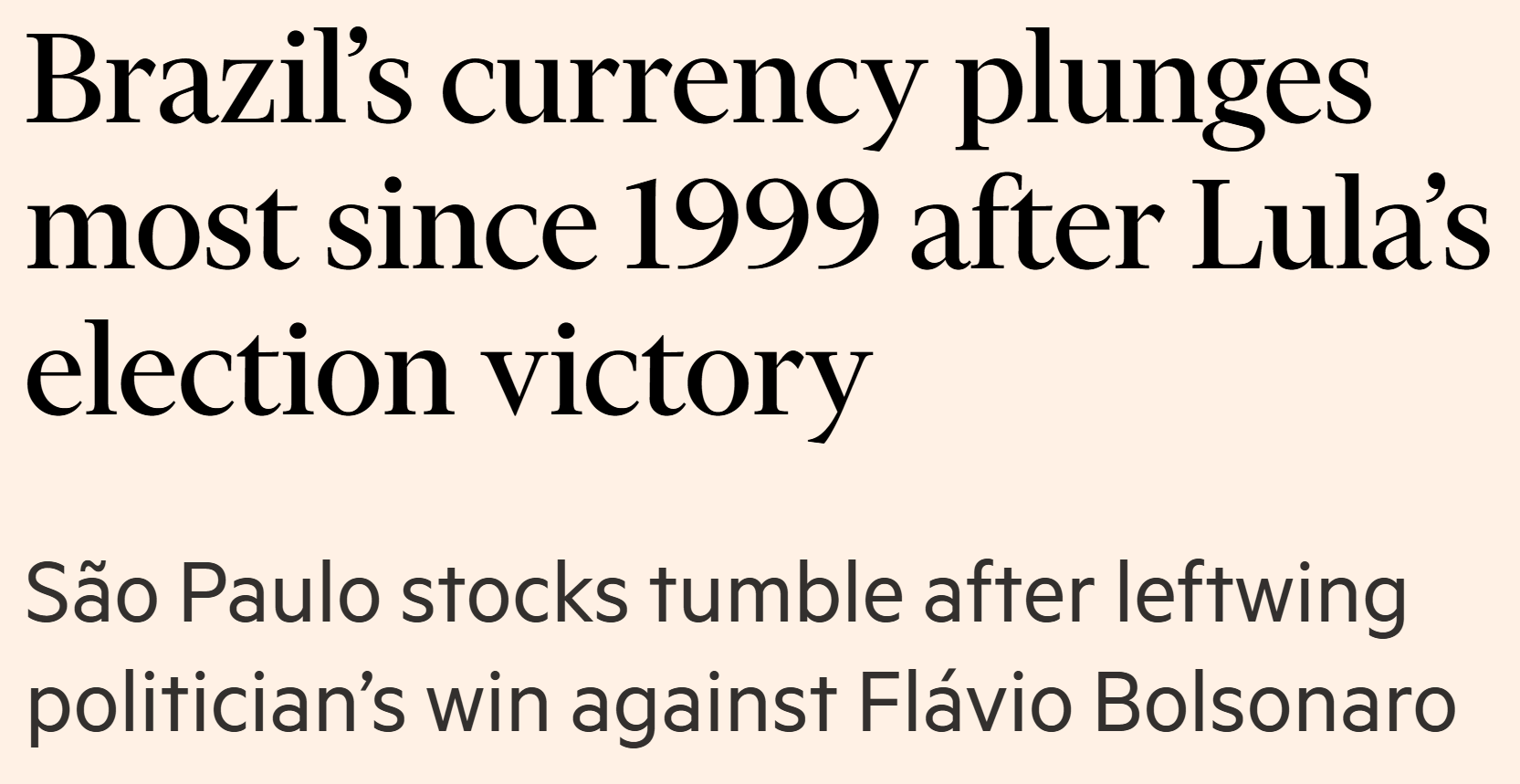 Another election with currency impacts this year. Source: Financial Times
Brazilian stocks (measured by the iShares MSCI Brazil ETF) plunged as much as 27% in premarket trading.
As one commentator put it: ‘In the end, the wealthy don’t protest, they simply exit.’
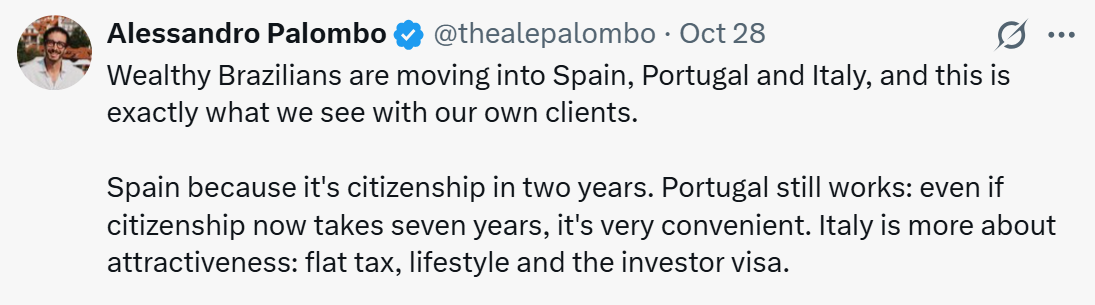
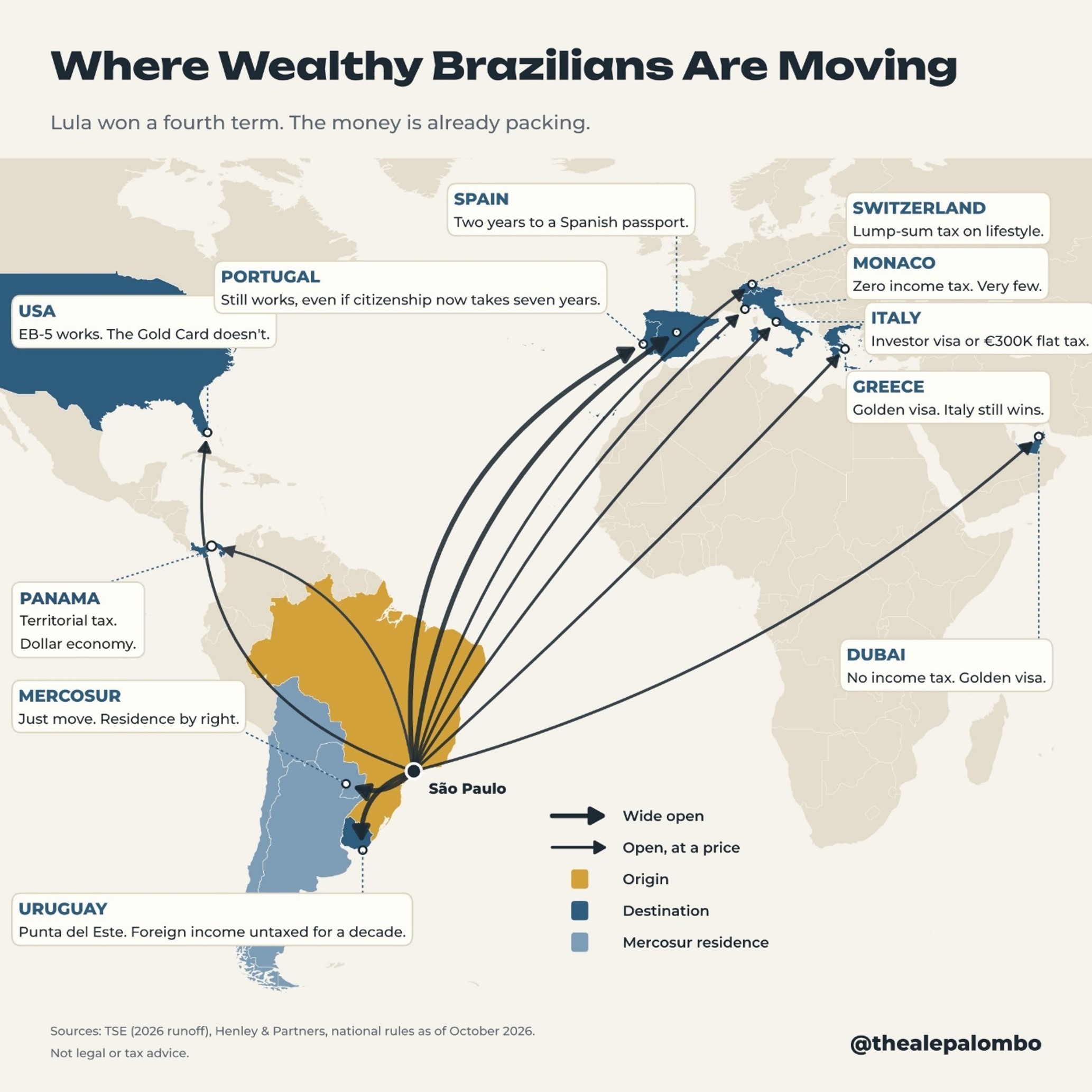 Source: Alessandro Palombo / X
Here in New Zealand, we face a pivotal election this Saturday.
The centre-right coalition has finally achieved economic growth ahead of Australia.
Is it too little, too late for people to notice a difference?
We now face a vote on some of the most radical changes to tax and wealth policy in a generation.
What many people don’t realise is that you simply get less of what you tax.
Now imagine that, on Saturday, a left-wing coalition has the numbers thanks to a strong showing from the Greens and TOP.
Coalition negotiations progress. Various policy proposals move onto the negotiating table, including:
- Capital gains tax on residential and commercial property.
- A 45% tax rate on income above $160,000.
- A 2.5% annual wealth tax on net-assets above $10 million.
- Inheritance tax on estates over $1 million (excluding the family home).
- Compulsory acquisition of up to a quarter of the nation’s supermarkets.
- The groundwork on a land tax to fund a Universal Basic Income (UBI).
Now, let’s consider the impact of the proposed policies on New Zealand.
(These are hypothetical scenarios assuming the introduction of multiple new taxes.)
A rush for the exit
Economic activity is mobile.
Capital, skilled workers, and business owners increasingly have choices about where they live, invest, and build companies.
New Zealand’s challenge is that its tax base is already unusually concentrated. Just 46,939 taxpayers contribute more income tax than 2.35 million people combined.
If even a modest proportion of high-income earners, entrepreneurs, and investors relocate abroad, the impact on government revenue could be disproportionate.
Australia remains only a short flight away.
As capital and talent leave, business formation slows. Investment decisions are deferred. Job creation weakens.
A country does not become poorer overnight. It becomes poorer one investment decision at a time.
The investment chill
Large investors value stability.
When property rights become less certain, taxes increase, or government intervention expands, investors reassess risk.
The question isn’t whether investors approve or disapprove of a government’s objectives.
The question is whether the return justifies the risk.
If investors conclude that future returns in New Zealand may be reduced by higher taxation or uncertainty, future investment simply goes elsewhere.
That means fewer new projects, fewer developments, and less competition.
Ironically, the people policymakers hope to help are often the ones who ultimately bear the cost through slower wage growth, reduced opportunity, and higher prices.
Accommodation pressures
Housing is ultimately governed by incentives.
When after-tax returns on residential property fall, fewer investors are willing to supply accommodation.
Developers become more selective.
Projects that once appeared viable become marginal.
The result is not necessarily an immediate decline in housing supply. Instead, future supply growth slows while demand continues.
Over time, that can worsen shortages and place additional pressure on rents and housing availability.
Currency markets cast their vote
Financial markets do not vote on election day.
They vote every day afterwards.
Money markets continuously assess whether countries are becoming more or less attractive destinations for capital.
New Zealand is particularly sensitive because it is a small, trade-dependent economy that relies on foreign capital.
If investors perceive policy settings as becoming less supportive of growth, productivity, and investment, they may demand a higher risk premium for holding its currency and assets.
That could place significant downward pressure on the New Zealand dollar.
While exporters may initially benefit, households could face higher costs for fuel, imported goods, and overseas travel.
Inflationary pressures could return at precisely the wrong time.
Why investors should pay attention
None of these outcomes are guaranteed.
Markets regularly overreact. Politicians compromise. Policies evolve.
But incentives matter.
History repeatedly shows that economies attracting capital, investment, and talent tend to prosper. Economies that make these things less attractive often struggle.
The real risk is not a single tax.
The real risk is the signal sent by a broader policy direction.
Investors around the world are constantly comparing opportunities.
New Zealand is not competing against its past.
It is competing against every other destination for capital.
For investors, the objective is not to predict every political outcome.
It is to ensure wealth remains resilient regardless of which path the country takes.
That means maintaining diversification across sectors, countries, and currencies.
Because elections come and go.
Preserving purchasing power and protecting long-term wealth remain the goals that matter most.
Regards,
Simon Angelo
Editor, Wealth Morning
(This article is the author’s personal opinion and commentary only. It is general in nature and should not be construed as any financial or investment advice. Please contact a licensed Financial Advice Provider to discuss your personal situation. Wealth Morning offers Managed Account Services for Wholesale or Eligible investors as defined in the Financial Markets Conduct Act 2013.)
Simon is the Chief Executive Officer and Publisher at Wealth Morning. He has been investing in the markets since he was 17. He recently spent a couple of years working in the hedge-fund industry in Europe. Before this, he owned an award-winning professional-services business and online-learning company in Auckland for 20 years. He has completed the Certificate in Discretionary Investment Management from the Personal Finance Society (UK), has written a bestselling book, and manages global share portfolios.