
Do you remember what it was like in the 1980s?
Well, Japan was experiencing a golden age.
Its economy was firing on all cylinders, running hot. Its exports were conquering global markets. Its asset prices were booming. Its investors were sitting on enormous paper wealth.
In just two generations, Japan had risen from the ashes of wartime defeat. It now appeared to be financially ascendant. Already, it had overtaken the United Kingdom in terms of real GDP per capita. It seemed poised to catch up to the United States as well…
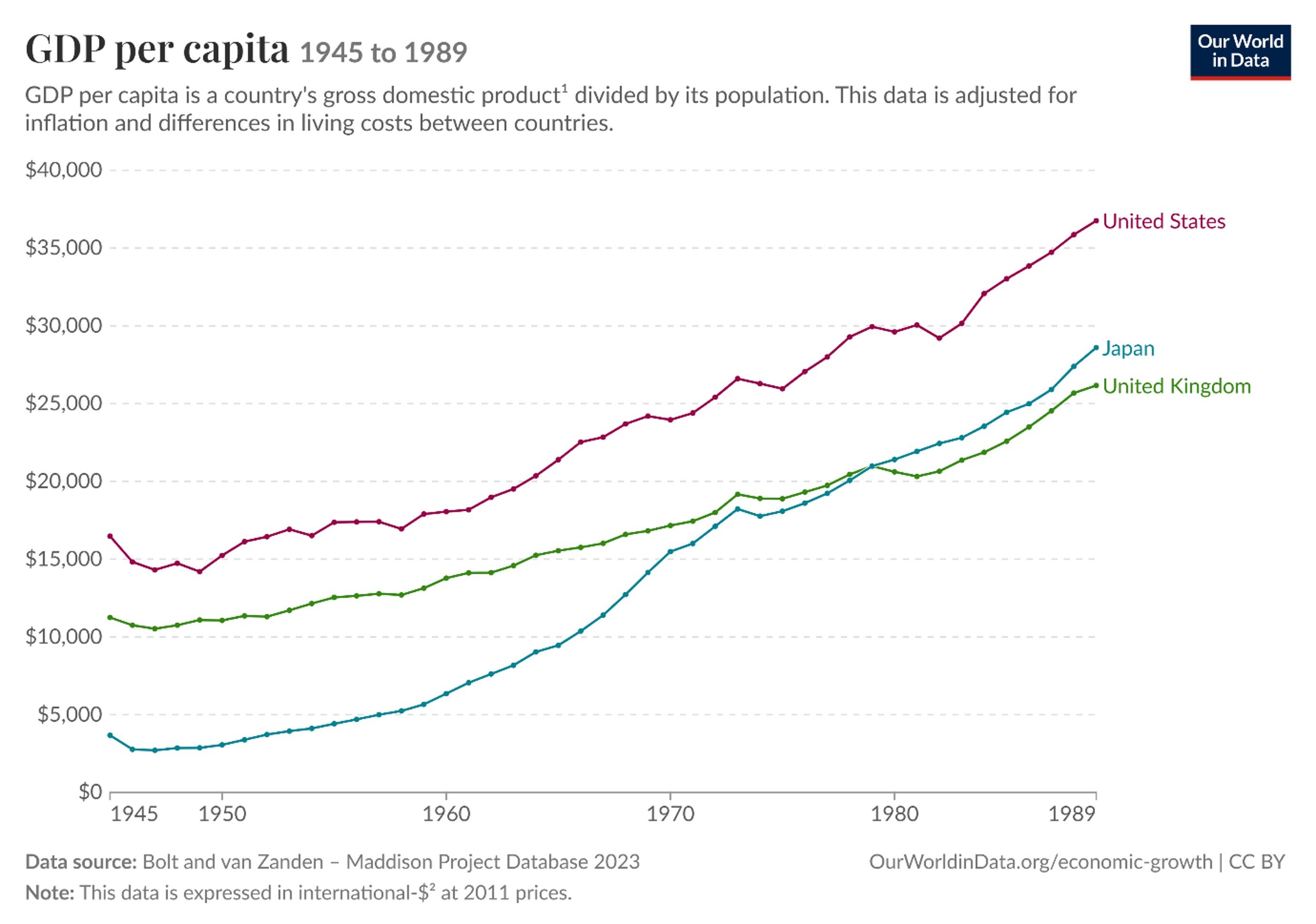
Source: Our World in Data
By 1989, the Japanese stock market was worth around US$4 trillion. It represented over 40% of the world’s total equity market capitalisation:
- Trading was feverish in Tokyo, with stocks on the Nikkei index changing hands at around 60 times earnings.
- Yes, things were looking eye-wateringly expensive. But nobody wanted to miss out. Stock prices had already tripled in four years.
However, the stock market wasn’t the biggest bubble forming. The property bubble was even larger. By 1991, the total value of real estate began to approach US$20 trillion:
- Incredibly enough, this meant that the value of the Japanese property market was five times greater than that of the United States.
- The grounds of the Imperial Palace in Tokyo alone were said to be worth as much as the entire state of California.
Of course, this speculative ride was too wild. Too crazy. It couldn’t possibly last. And sure enough, the tide turned. Asset prices started to crumble:
- By 1992, the Nikkei had fallen more than 60% from its peak. Meanwhile, property values plunged by as much as 80%.
- Banks were left sitting on mountains of bad loans. Businesses stumbled. Wages froze. And everyone learned a brutal lesson: inflation was being replaced by deflation.
What followed became known as the Lost Decades. During the worst stretch, aggregate land values steadily declined for 15 years straight. It was slow, persistent, and traumatic:
- This had a profound impact on Japanese behaviour. Households tightened their belts. Consumers delayed spending. Companies avoided investing.
- When interest rates remained pinned near zero, banks found it increasingly difficult to earn attractive spreads from the simple business of borrowing and lending.
- As consumption fell, people got into the habit of hoarding their surplus funds in cash and deposits.
This was, quite literally, a doom loop:
- From 1990 to 2025, Japan’s GDP per capita in purchasing-power terms rose only around 30%. By comparison, other countries in Asia zoomed ahead. China’s GDP per capita rose fourteenfold. India’s rose fivefold. South Korea’s rose fourfold.
- In 2025, Japan’s gross government debt sat at over 206% of GDP. That is the second-highest ratio in the world. For three decades, the only thing that made this survivable was interest rates pinned at zero — and then below zero.
- Japan was suffering from a poisonous cocktail. A combination of economic stagnation, funding deficits, and rising welfare costs. The nation was apparently stuck in a rut, even as its population aged. It just couldn’t break free.
But watch out. Every cycle, no matter how miserable, must eventually turn. And right now, Japan’s long financial winter does appear to be easing:
- In March 2024, the Bank of Japan formally abandoned both its negative-interest-rate policy and its yield-curve-control framework.
- Then, in June 2026, the BOJ did something more significant. It hiked its benchmark interest rate to 1%. This was the highest in three decades.
- Why did they do this? Well, because the economy now appears to be switching gears. Forget deflation. Say hello to inflation.
- In July, the nation’s headline consumer-price index increased 1.9% year-on-year. At the same time, inflation-adjusted wages rose 2.4%. This was the strongest gain since May 2021, representing the seventh consecutive monthly increase in real wages.
- In September, the BOJ hiked its benchmark rate again, this time to 1.25%. Meanwhile, the consumer-price index accelerated to 2.7% year-on-year. This seems to indicate that more interest rate hikes are likely.
- So, right now, the financial landscape is shifting in Japan. It feels seismic. Workers are receiving larger pay rises. Consumer prices are climbing. Indeed, not many nations have travelled a stranger road than this.
For me, this raises an intriguing question: ‘Who benefits when a deflationary economy suddenly begins to experience inflationary pressure?’
- Well, lately, I’ve been watching one Japanese business. It has spent years operating in the most hostile environment imaginable for a traditional lender. It has survived the worst of the downside, proving itself to be resilient.
- So now, given the circumstances, could this business be well-positioned for the next stage of the cycle? Could it actually benefit from rising interest rates?
Your first Quantum Wealth Report is waiting for you:
⚡🌎 Start Your Subscription: NZ$37.00 / monthly
⚡🌎 Start Your Subscription: US$24.00 / monthly


John is the Chief Investment Officer at Wealth Morning. His responsibilities include trading, client service, and compliance. He is an experienced investor and portfolio manager, trading both on his own account and assisting with high net-worth clients. In addition to contributing financial and geopolitical articles to this site, John is a bestselling author in his own right. His international thrillers have appeared on the USA Today and Amazon bestseller lists.