
I want to take you on a trip down memory lane.
All the way back to 1972.
There’s no hiding it: this was a horrible year.
The Vietnam War was grinding toward its tragic conclusion, sapping American morale. Meanwhile, inflation was starting to bite, putting pressure on the economy.
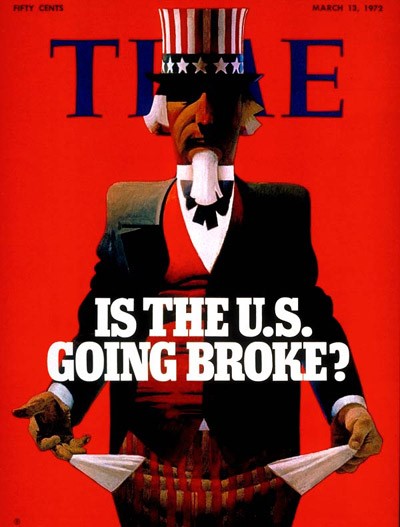
Then, in March of that year, Time magazine ran a cover that captured the national mood perfectly.
It showed Uncle Sam with his pockets turned inside out. Empty. Penniless. And the headline asked a terrifying question…
Source: Time
The national debt had ballooned to over $420 billion. This was an astonishing number at the time. Economists buried their faces in their hands, horrified.
- The sour mood deepened with stagflation. Oil shocks. Gas lines snaking around the block. Paul Volcker hiking interest rates up to a punishing 20%.
- The story wrote itself: America had spent too much. Promised too much. Borrowed too much. Surely, the economy was finished. How could the nation possibly survive this mountain of red ink?
- The experts could see no way out of this. But — surprise, surprise — they were wrong. Totally wrong. Because what happened next was absolutely staggering…
Source: Macrotrends
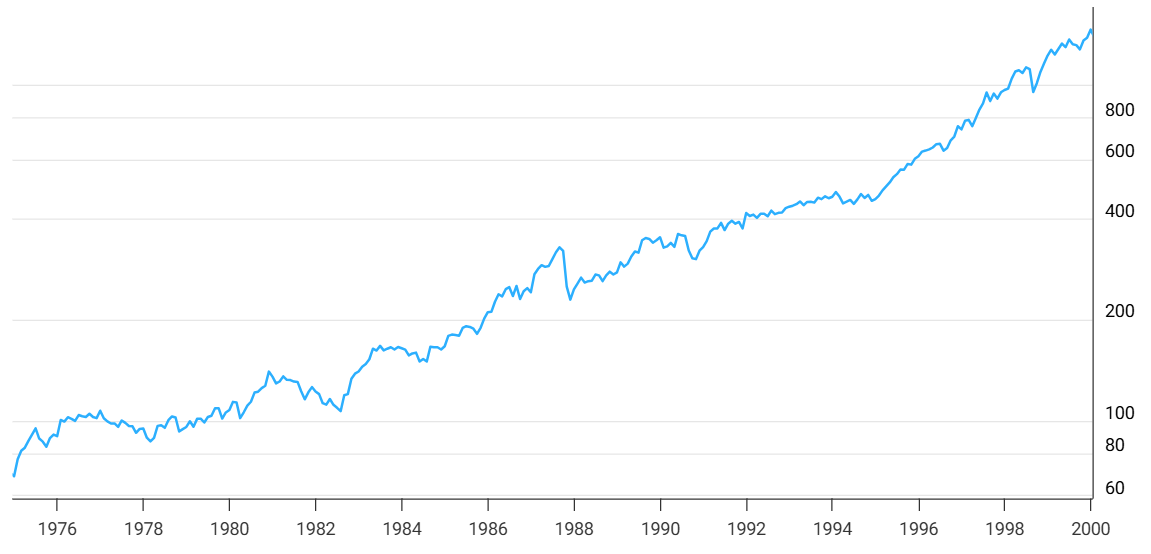
America didn’t collapse. Instead, it staged one of the greatest comebacks in human history:
- From 1975 to 2000, America’s GDP growth exploded, achieving a fivefold increase. This propelled the S&P 500 into an incredible bull run, where it delivered a nominal return of almost 2,000%.
- What we got during this 25-year period was a spectacular wealth engine. Personal computers. The internet. The end of the Cold War. The surge of free enterprise. A generation of baby boomers who grew rich while the pessimists kept waiting for a funeral that never came.
- Was the fear of collapse exaggerated? Was it oversold? Well, yeah. The experts failed to predict the wave of prosperity in the 1980s and 1990s. Imagine that.
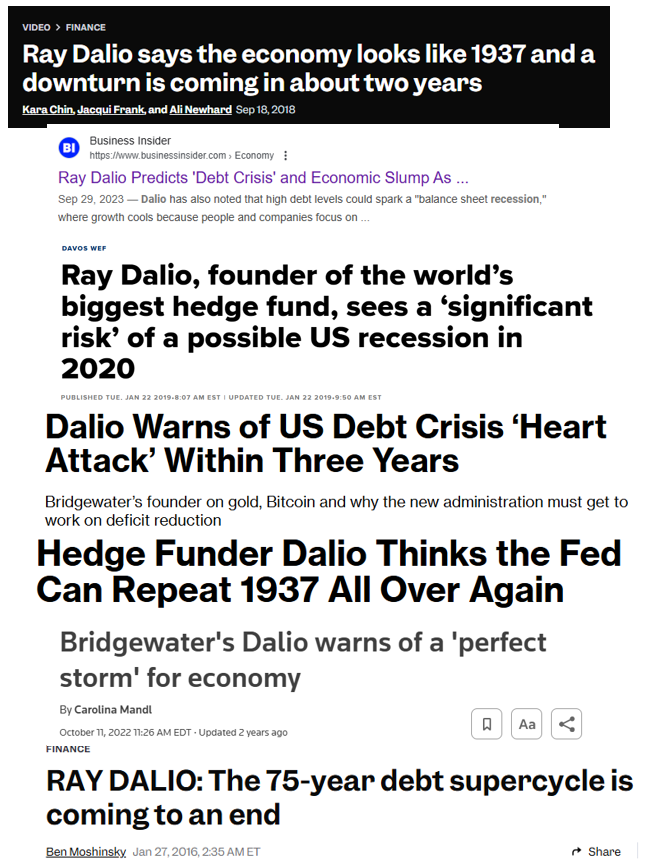
- But, of course, that doesn’t stop them from making more forecasts. Just take a look at these gloomy statements, courtesy of Ray Dalio…
Source: Ben Carlson / A Wealth of Common Sense
I think what was true in 1972 still holds true in 2026:
- The prophets of doom are a stubbornly pessimistic bunch. They are still making apocalyptic predictions. The scary headlines are back. America’s national debt is closing in fast on the $40 trillion mark. That number seems mind-blowingly huge.
- Once again, the story writes itself: America is spending too much. Promising too much. Borrowing too much. Surely, the economy is finished. How can the nation possibly survive this mountain of red ink?
Source: Political Calculations
Once again, I suspect the fear has been overdone:
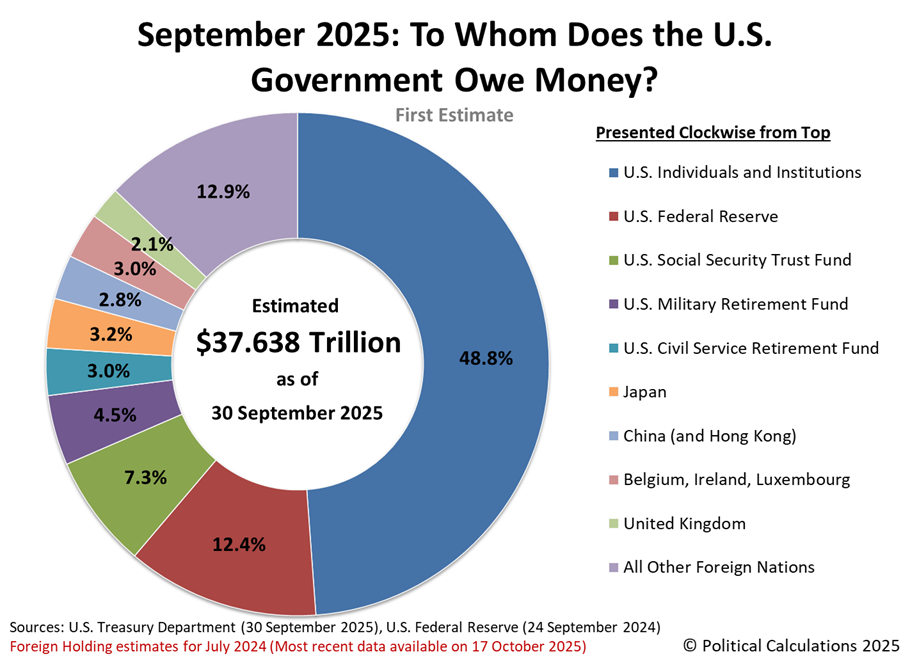
- When critics talk about the national debt, they usually picture America being held hostage by foreign powers. They imagine the communists in Beijing acting like bullies. Controlling the national mortgage. Ready to foreclose on Washington at a moment’s notice. Creating a financial disaster.
- But wait. Hold on. That’s not the truth. Look closer. You can see that over 75% of America’s debt is actually owned domestically. It belongs to local individuals and local institutions.
- This means that when America pays interest on this debt, most of those cheques are written out to Americans. I’m talking about pension funds and hedge funds, as well as ordinary people holding Treasury bonds.
- Meanwhile, foreigners only own a very thin slice of the debt pie. For example, China owns less than 3% of it. The dragon’s grip is far weaker than the headlines might suggest.
Source: Eugene Ng / X
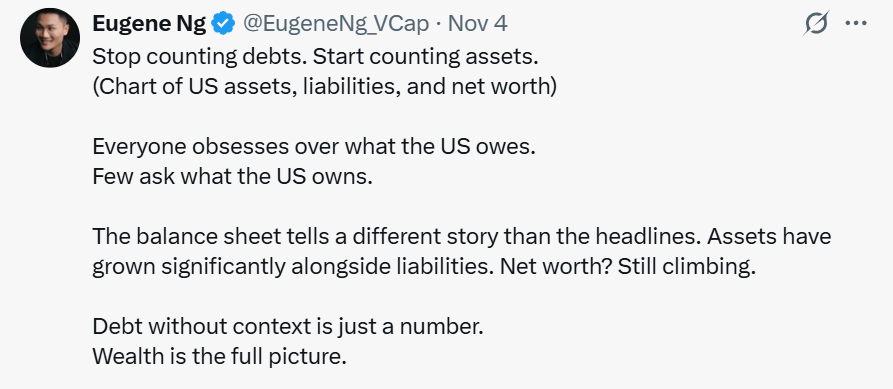
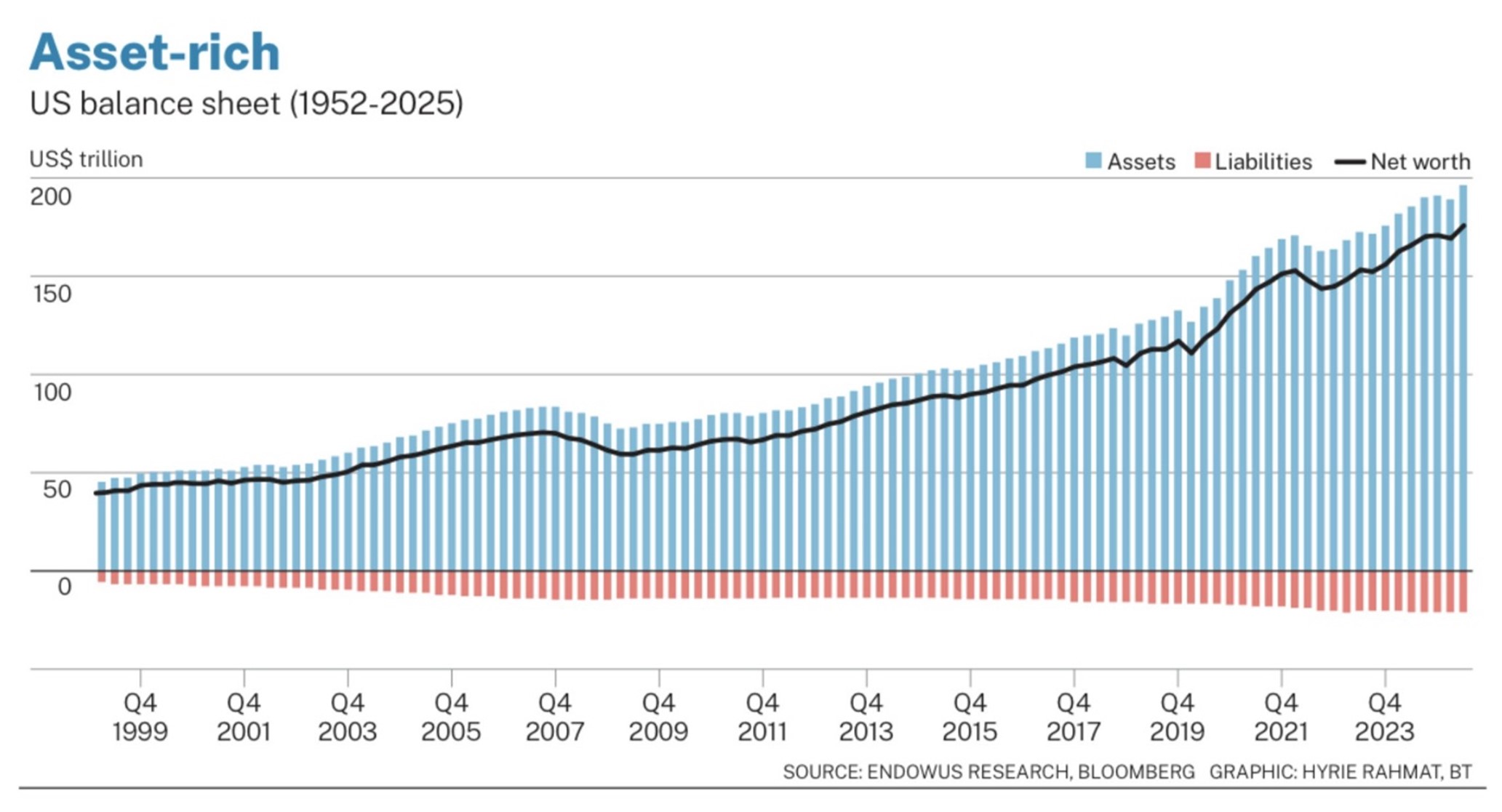
Perhaps the fear comes from a misunderstanding about what America’s balance sheet actually looks like:
- On one side, you’ve got liabilities. Meanwhile, on the other side, you’ve got assets.
- So, which matters more in the long run? Liabilities or assets?
- Well, the short answer is this: assets.
- I’ve always found it curious that the pessimists keep obsessing over one side of the ledger, while totally ignoring the other.
Source: Ryan Detrick / X
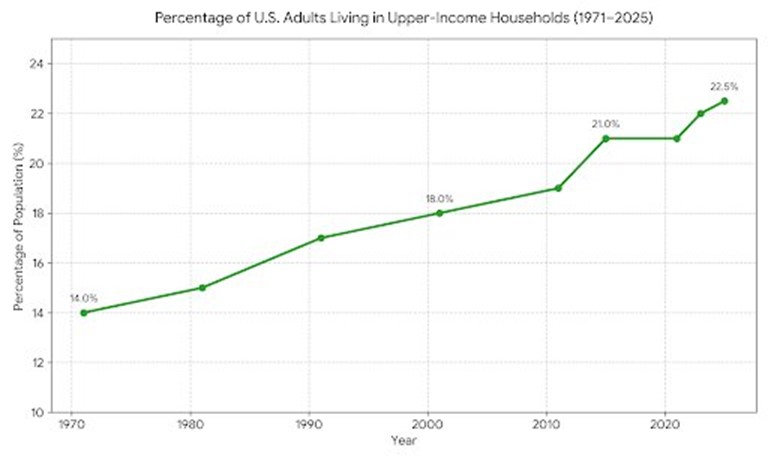
Also, here’s another piece of the puzzle that I want you to consider. It’s the financial health of American households. This is worth examining closely:
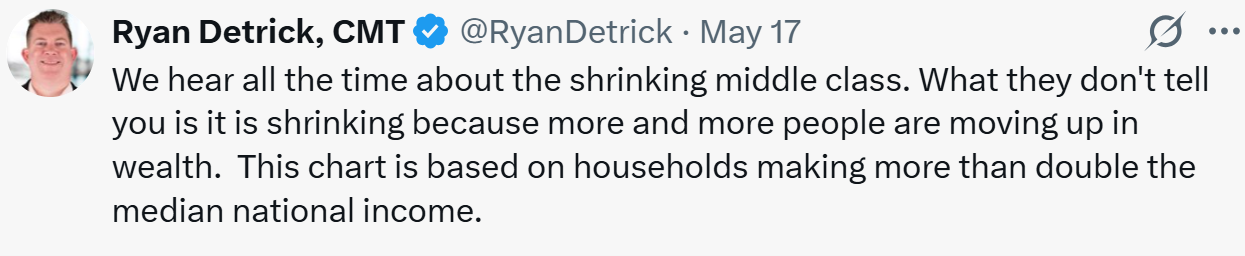
- The critics will say that the middle class is dying. The American Dream is dead. The little guy can’t catch a break.
- But that perception is wrong. The middle class is shrinking only because more people are actually moving up. Look at the trend. Back in 1971, just 14% of American adults lived in upper-income households. By 2025, that figure had risen to 22.5%.
- This is not decline. This is social mobility. The quiet miracle of prosperity. And I actually think it gets better. Because when we add up everything that American households own, the picture becomes truly extraordinary.
Source: Peter Mallouk / X
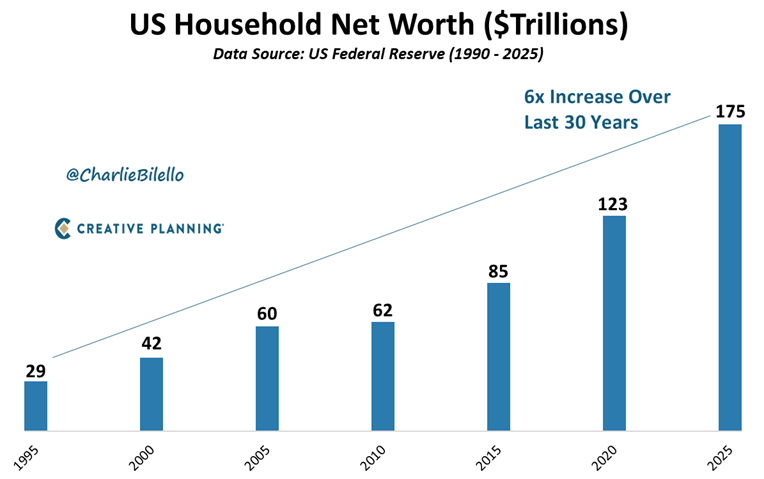
I believe this deserves to be on the front page of every newspaper:
- Back in 1995, the total net worth of American households was about $29 trillion. By 2025, it had rocketed to roughly $175 trillion. That’s a sixfold increase in just three decades.
- And the climb hasn’t stopped. According to the Federal Reserve’s most recent figures, household net worth is still surging. It has just passed the $184 trillion mark. It’s marching steadily towards $200 trillion.
So let’s do the math:
- On one side of the ledger, you have American national debt approaching $40 trillion.
- Meanwhile, on the other side, you have American household net worth approaching $200 trillion.
- Which matters more? Well, you don’t need to be an economist to understand the significance here. American households are sitting on a pile of wealth almost five times the size of the entire national debt.
Indeed, this is a rich nation. Past generations could barely conceive of such prosperity. And yet, somehow, the story we’re being told today is that America is on the brink of ruin:
- So why the relentless misery? Why does the media refuse to celebrate American success? Well, again, I think it’s because negativity sells. This is why the prophet of doom gets invited back on television. Meanwhile, the cheerful realist gets ignored.
- Regardless, I believe it’s better to be optimistic than pessimistic. If you want to understand why, just look at the longest view of all.
Source: BlackRock
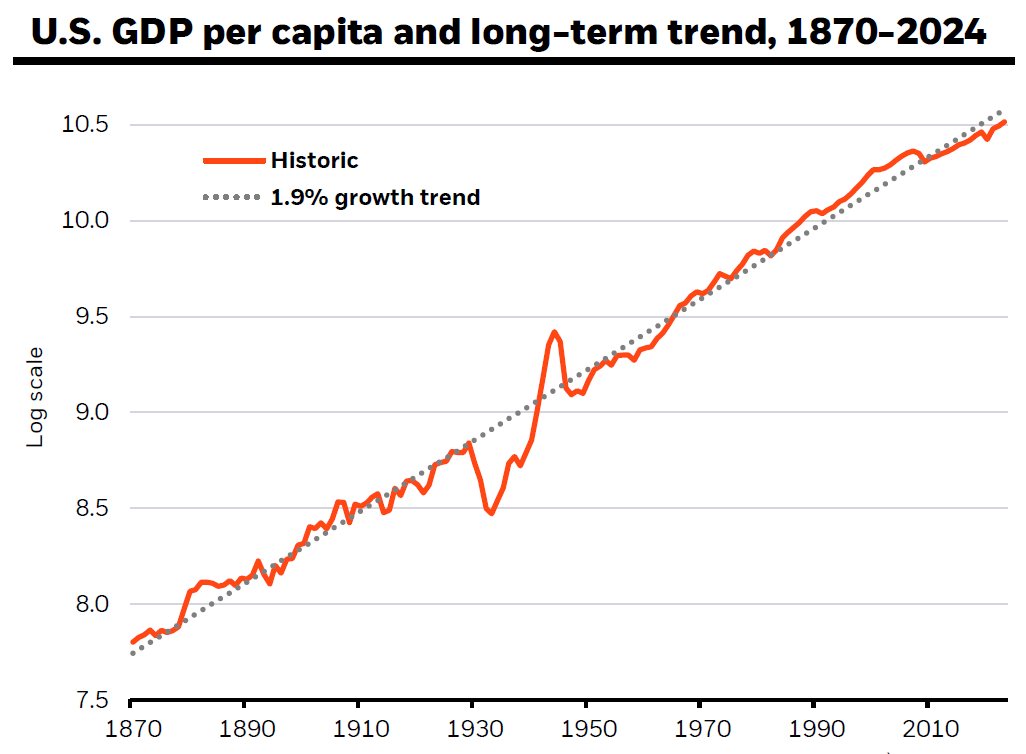
This chart tracks US economic output per person all the way back to 1870. That’s more than 150 years of history, plotted on a single line:
- Look at what it shows. A steady, relentless climb. Compounding growth, decade after decade, generation after generation.
- The American economy endured the panics of 1873 and 1893. The Great Depression of the 1930s. The stagflation of the 1970s. The dot-com crash of 2000. The Global Financial Crisis of 2007. The Covid pandemic of 2020.
- Every single time, the economists said this was the end. And every single time, America defied their expectations. The line dipped, wobbled, and then climbed right back to trend. Painfully. Stubbornly. Relentlessly upward.
This is a historical marvel, isn’t it? People are surprisingly resilient. They will keep pushing forward, making progress:
- Mind you, this is not just an American story either. It’s a global one. I can’t help but reflect on my own family. Generations that clawed their way from dirt-poor peasantry in China to middle-class prosperity in New Zealand. It’s the slow generational miracle of compounding. Not just of money, but of grit, of hope, of opportunity passed from one set of hands to the next.
- We endure crisis. We navigate fear. We carry on. That’s what the data really represents. Not abstract economics. Human beings building something better for their children. One stubborn year at a time.
Warren Buffett, a great value investor, has spent his life watching the market. In his 2021 letter to shareholders, he observed:
‘Despite some severe interruptions, our country’s economic progress has been breathtaking. Our unwavering conclusion: Never bet against America.’
Yes, I agree with Buffett on this one:
- America is not perfect. Far from it. The nation is often messy. Argumentative. Contradictory. Maddening.
- But it is also adaptable. Innovative. Self-correcting. Resilient. And for long-term investors, I think that still matters. Maybe more than ever.
It’s time to have your say
I hope that you’ve enjoyed reading our articles as much as we’ve enjoyed writing them:
- Your prosperity is our focus — which is why we are always working hard to uncover new opportunities beyond the radar for you.
By the way, I have a small favour to ask:
- Would you like to write a review of our work here at Wealth Morning?
- Do you want to let us know if our stories have inspired you in a positive way?
- Do you want to let us know if our stories have helped you become a more successful investor?
We truly value your feedback. It encourages us. It helps us to do better. It helps us to reach further:
- So, if you’d like to leave us a review, it’s quick and easy. It will only take two minutes of your time.
- Thank you so much in advance for your kindness and generosity. Your readership keeps us going!
Regards,
John Ling
Analyst, Wealth Morning
(This article is the author’s personal opinion and commentary only. It is general in nature and should not be construed as any financial or investment advice. Wealth Morning offers Managed Account Services for Wholesale or Eligible investors as defined in the Financial Markets Conduct Act 2013.)

John is the Chief Investment Officer at Wealth Morning. His responsibilities include trading, client service, and compliance. He is an experienced investor and portfolio manager, trading both on his own account and assisting with high net-worth clients. In addition to contributing financial and geopolitical articles to this site, John is a bestselling author in his own right. His international thrillers have appeared on the USA Today and Amazon bestseller lists.