
Do you want to hear a funny story?
Well, I’ll tell you a funny story.
One day, a man is feeling depressed.
So he books an appointment to see a psychiatrist.
As he reclines on the couch, the man pours out his heart’s sorrows. He says that life seems gloomy. He feels all alone in this cruel world. He is convinced that things are only going to get worse.
The psychiatrist nods and takes notes. Then he looks at the man with a knowing smile: ‘Oh, I understand what you’re going through. I think the treatment for this is very simple. The great clown Pagliacci is actually in town this week. He’s an absolutely brilliant performer. You should go to one of his shows. He’ll make you laugh. He’ll cheer you up. Guaranteed.’
The man stares at the psychiatrist, his lips quivering, his eyes watering. Then he buries his face in his hands and sobs: ‘But, Doctor, you don’t understand. I am Pagliacci the clown.’

Source: Image generated by OpenAI
This story is darkly humorous, isn’t it? I first came across a version of this joke in Alan Moore’s Watchmen. I think it reveals an essential truth about human nature:
- Positivity or negativity is largely a state of mind. Indeed, our outlook is a powerful force. It shapes how we see the world.
- You can apply this to any number of things. Our health. Our relationships. Our politics. Even our investment decisions.
Lately, I’ve been thinking about the state of play in the market:
- There’s a lot of talk about a looming tech crash. The pessimists say this will resemble the bursting of the dot-com bubble of the early 2000s. They say we’re facing a lost decade.
- Of course, for people with jittery nerves, this sounds terrifying. So their immediate instinct is to avoid investing altogether. They start to hoard cash. They imagine the worst. They imagine a doomsday scenario.
- But here’s the thing: what they are picturing in their mind actually bears no relation to the truth.
- The truth, as it turns out, is much more interesting. Because here’s what the lost decade really looked like…
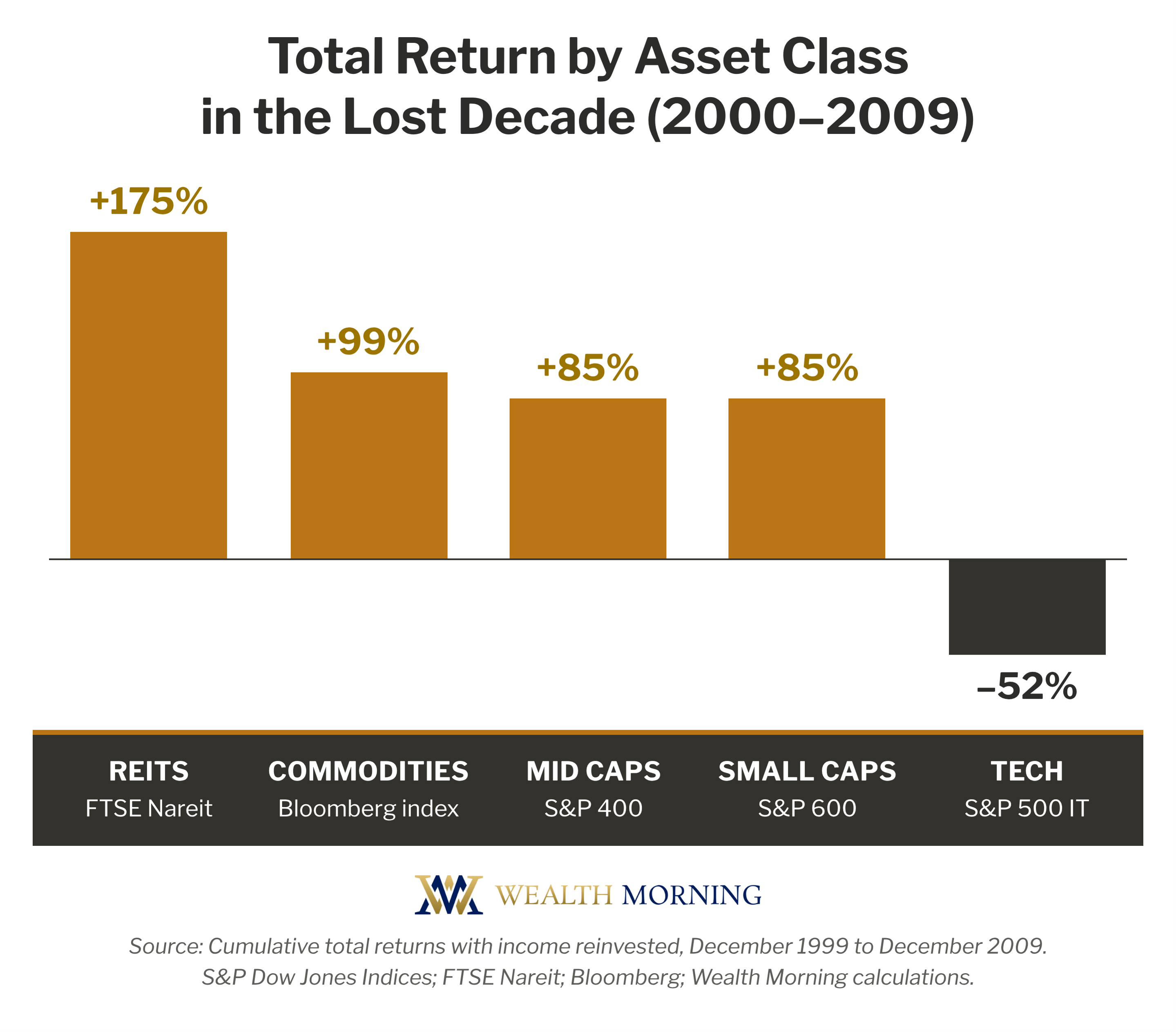
It’s fascinating, isn’t it? Let me walk you through this:
- In the aftermath of the dot-com bubble, what we got was a period where tech stocks underperformed. But surprisingly enough, other asset classes outperformed.
- The biggest winner here? REITs — real estate investment trusts. These are companies that run shopping malls, industrial warehouses, healthcare properties, apartment buildings. They accelerated because they were attractively valued and income-rich.
- Meanwhile, the commodity sector also boomed. It enjoyed a new supercycle for global energy, fuelled by tailwinds for oil and gas. By 2005, ExxonMobil had become the largest company in the world.
- Finally, mid caps and small caps also punched above their weight. Quite quickly, they filled the gap left behind by large-cap tech stocks.
- So, as you can see, the lost decade wasn’t really a lost decade at all. It was actually a great rotation. A seismic shift that rewarded investors who were agile and decisive.
Source: Alex Hormozi / X
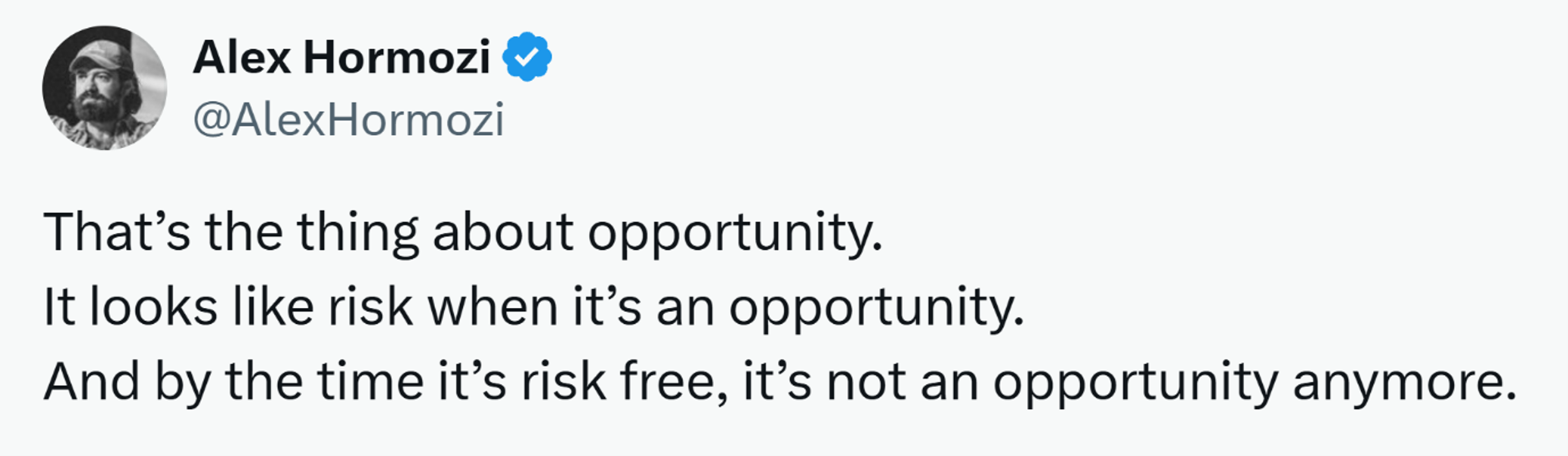
I believe what was true in 2000 is still true today in 2026:
- Yes, there are people who are being emotional about the market. They keep talking about how expensive tech stocks have become. They agonise about whether the promises associated with AI are too stretched to be sustainable.
- But are these people missing the point? There’s actually an entire universe of assets out there that isn’t tech. The problem here is that they haven’t taken the time to look at wider opportunities.
Let’s face it. Cycles move. Cycles change. Always have. Always will. What’s important here is having the ability to see beyond the curve:
- Yes, those who are fearful will talk about crashes. But those who are courageous will talk about rotations.
- I believe what matters most is having the right perspective. Over the long run, an open mind will almost certainly fare better than a closed one.
- This is especially true for an investor who’s searching for value assets that may offer a resilient runway of income and growth. The ability to be adaptable — more than anything else — is where positive results will come from.
- Focus less on market crashes. Focus more on market rotations.
Are you looking for someone to stand up for you?
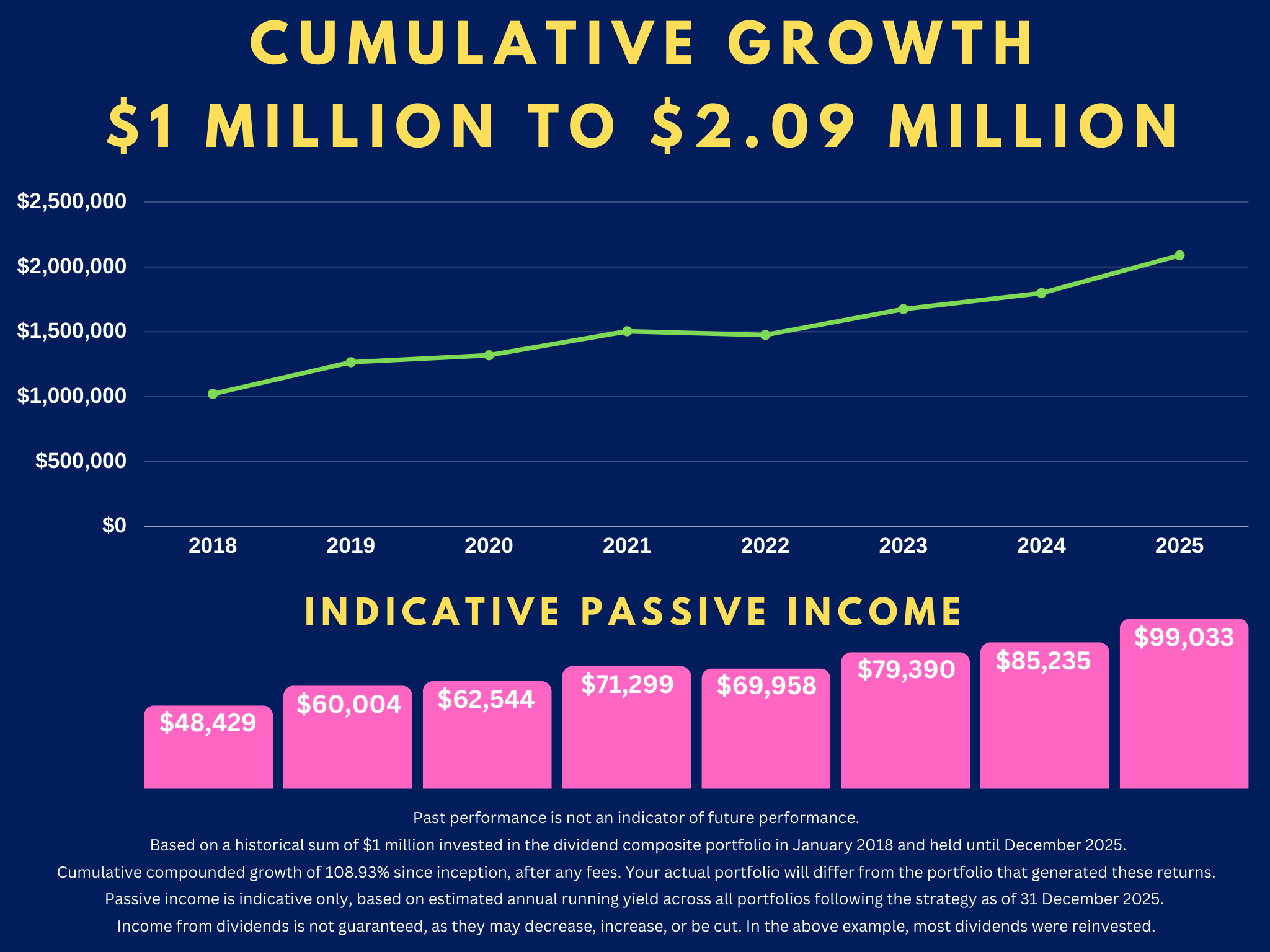
Here at Wealth Morning, we run what may be the only active night-trading desk in New Zealand for our Eligible and Wholesale Clients:
- Every week, we aim to buy into exceptional companies in Australia, Europe, and America.
- Our focus is on sectors that offer the perfect balance of growth and income.
- Our mission? To capture pockets of outstanding opportunity where we can.
- Where others see doubt, we see clarity — and we aim to use it as a springboard to build a better future.
- Are you interested? 👉 Click here to book a consult with us. Find out more about our Quantum Income Strategy, available exclusively to Eligible and Wholesale Investors.
Regards,
John Ling
Analyst, Wealth Morning
(This article is the author’s personal opinion and commentary only. It is general in nature and should not be construed as any financial or investment advice. Wealth Morning offers Managed Account Services for Wholesale or Eligible investors as defined in the Financial Markets Conduct Act 2013.)

John is the Chief Investment Officer at Wealth Morning. His responsibilities include trading, client service, and compliance. He is an experienced investor and portfolio manager, trading both on his own account and assisting with high net-worth clients. In addition to contributing financial and geopolitical articles to this site, John is a bestselling author in his own right. His international thrillers have appeared on the USA Today and Amazon bestseller lists.