
Election nights are often emotional affairs.
Markets dislike uncertainty, and many voters wake the next morning feeling disappointed, relieved, or frustrated.
After watching the results come in, three observations stood out.
First, MMP continues to produce unstable outcomes
The electoral system is the foundation of everything that follows.
Years ago, I lived in a beautifully restored apartment building in Europe.
It looked impressive from the road, but flaws in its redevelopment led to persistent water ingress and maintenance issues. Those design decisions would continue to create problems long after construction was complete.

MMP sometimes feels similar. The system was designed to improve representation, but it can also produce fragmented results, complex coalition negotiations, and prolonged uncertainty. Small parties can find themselves exercising significant influence despite receiving relatively low levels of support.
That may be a feature to some voters. To others, it increasingly looks like a flaw.
Second, New Zealand remains deeply divided
Rural and coastal-suburb electorates are conservative. The North Shore of Auckland is entirely blue. Most of the west and south is red.
Other large cities — especially Wellington and Dunedin — vote red or green. We orbit different world views.
Now, here’s the peculiar thing. Some of the most expensive areas within all of these appear to have a high turnout for the Left.
The leafy streets of my voting booth saw almost equal support for the Labour candidate — and 15% support for TOP. This in an area where average home values exceed $2 million.
As it turns out, blue rinse likes teal. Virtue is often cheapest when the bill arrives after you’ve made your fortune.
What is clear is that New Zealand increasingly contains multiple political realities operating side by side.
Third, opportunity was squandered
Like the American midterms, I suspect many voters used the opportunity to punish moderates. Politicians were given a few years to act strongly and decisively. Instead, bureaucracies and special interests were maintained.
A huge amount of work was put in to educate people on the MMP system. On how centre-right voters could use their two votes for maximum advantage.
To be fair, the campaign wasn’t without success. NZ First climbed from around 6% to almost 10%, while ACT increased its support from 8.6% to 11%. In an MMP election, those are meaningful shifts.
But people in National continued to push for their party vote, seeing hundreds of thousands of wasted votes. Others in critical electorates chose to split candidate votes.
Meanwhile, there was the distraction of some very misjudged comments, amplified by media that already seemed leery of the government.
The positive
Despite the uncertainty, the centre-right remains in the strongest position to form a government.
If that comes to pass, let’s hope they’ve learnt some lessons.
Clearly, the role of the media needs to be considered carefully.
Whether intentional or not, it seems ironic that taxpayer-funded media provided considerable exposure to a new party that may now occupy a kingmaker position.
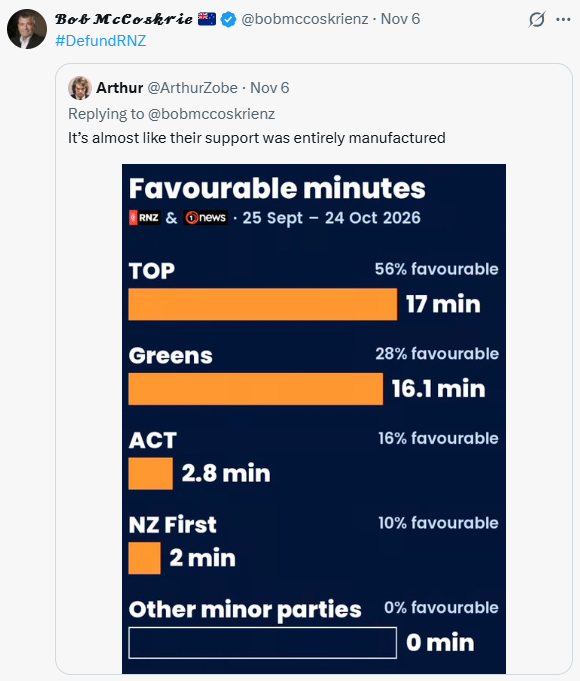
Source: Bob McCroskrie / X
On the other side, Reality Check Radio — a listener-funded station — promoted a vote-splitting campaign that explored the extent of the MMP system. They receive no government funding.
In the event a left-wing coalition is formed, the probability of some of the more extreme proposals (land, wealth, capital, and inheritance taxes) does face some challenges.
As investors, it is futile to focus on what you cannot control.
Elections and governments come and go. The fortunes of individual countries rise and fall.
Financial markets provide a much more diverse set of opportunities around the world. At any point in time, there is often quality and value somewhere.
From a small country, it’s important to look outward and consider diversification: different countries, wider industries, a basket of currencies.
There is also a lot you can do from a tax perspective. For those comfortable with risk, leverage can accelerate returns and may provide tax deductions. Portfolios can often be structured more tax-efficiently within the rules.
I will explore this in more detail in our Premium News.
For now, stay calm and focused on your long-term goals.
The rivers of politics and markets are always turbulent.
Fortunately, there are deeper rivers.
Regards,
Simon Angelo
Editor, Wealth Morning
(This article is the author’s personal opinion and commentary only. It is general in nature and should not be construed as any financial or investment advice. Please contact a licensed Financial Advice Provider to discuss your personal situation. Wealth Morning offers Managed Account Services for Wholesale or Eligible investors as defined in the Financial Markets Conduct Act 2013.)


Simon is the Chief Executive Officer and Publisher at Wealth Morning. He has been investing in the markets since he was 17. He recently spent a couple of years working in the hedge-fund industry in Europe. Before this, he owned an award-winning professional-services business and online-learning company in Auckland for 20 years. He has completed the Certificate in Discretionary Investment Management from the Personal Finance Society (UK), has written a bestselling book, and manages global share portfolios.