
A friend recently came back from Britain.
He spent time speaking with business owners and younger people working in stores.
The feedback on the state of that economy was repeatedly concise: ‘Britain is f@#d.’
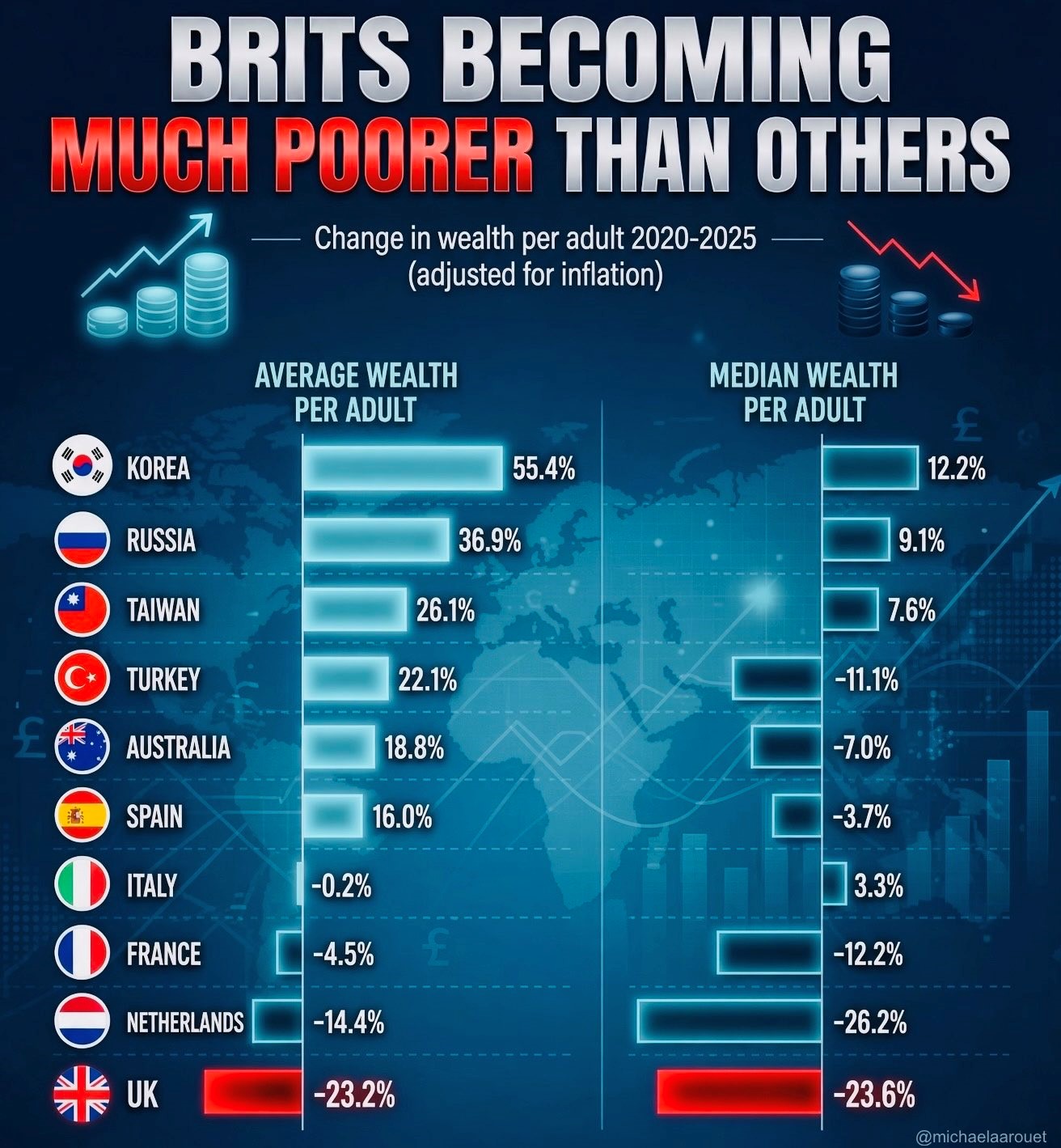
There were, of course, a few prosperous bubbles. But by and large, he came across a country much poorer and dirtier than when he’d left it in the 1990s.
One thing hadn’t changed. More and more productive people were looking to get out.
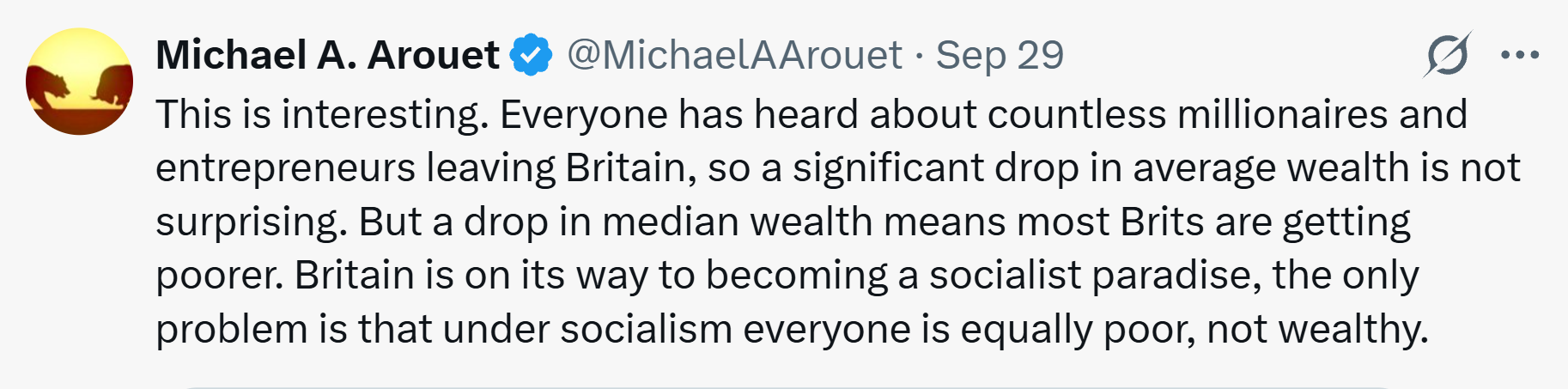
Incentives drive everything. Britain’s mistake is one of disincentivising businesses and wealthy people.
Source: Michael A. Arouet / X
It’s hard to hire and fire in modern Britain. Rates, rules, and regulations make turning a profit very difficult. The incentives to achieve higher incomes, invest capital and leave a legacy for the next generation are upside down.
When you consider personal allowances, some higher earners see an effective marginal rate of 60%. Capital gains taxes at up to 24% discourage equity investment. Inheritance tax at 40% (over £325,000) discourages generational wealth.
These policies penalise builders and makers. The very people a country relies on to generate prosperity.
Why incentives matter for New Zealand
Here in New Zealand, 97% of our businesses are SMEs. The ideal scenario is that the owners of these businesses will invest and grow to the point that some may become larger enterprises and grow wealth. Some may list on the stock market.
For me, the best policy I’ve seen come out of the current election cycle is the proposal by New Zealand First to reduce company tax from 28% to 20% for businesses with turnover under $30m.
Now, I don’t agree with all their policies — but let me explain why I find this change so beneficial to increasing wealth in New Zealand:
- Companies generally pay most of their profits to employees or shareholders at their tax rates. The key is retained earnings for future growth.
- When we invest in listed companies on the stock market — yes, we like some dividends to pay us to wait — we’re essentially investing for future growth.
- A 20% tax rate makes it much more beneficial to retain and invest for future growth between tax years.
- Traditionally, New Zealand trusts have been used to build and protect wealth. These face a tax rate of 39% for undistributed earnings.
- Companies could instead be used to build wealth across tax years, with the possibility that where the purpose is reinvestment, profits would only be taxed at 20%.
- An ideal structure for investors may well be a Company with the majority beneficial owners being trustees of a family trust, with smaller ownership by individuals to allow for distributions.
- New Zealand companies would be attractive not only for locals, but for offshore investors who may look at our safe haven as an alternative to jurisdictions like Singapore or Ireland.
- Moreover, New Zealand would be much more attractive for corporate investment compared to Australia, which has a base rate of 25% for companies with turnover below A$50m.
If we want to build more businesses, incentivise people to grow their wealth in New Zealand and keep more of our most productive people here, this sort of policy could be a real winner.
Opposition policies: the incentive test

Want a stronger economy? Start by incentivising entrepreneurs.
Source: Image by Fran Soto from Pixabay
Labour wants to add 28% capital gains tax on commercial and residential properties beyond the family home. This is an even higher rate than is levied in the UK.
It may be good for share investors, attracting more money to equity markets. Yet for local companies, it increases the cost of their property. If they own and develop property, any gains come with a hefty penalty. Landlords may need to up rents to factor in the lifetime ownership cost. All this leads to lower profits, less growth — and ultimately less wealth.
The Greens propose a 2.5% annual wealth tax on assets above $10 million, plus a 33% inheritance tax over $1 million. These policies would likely push many of New Zealand’s most productive citizens offshore — reducing the tax base and increasing pressure on everyone else.
They do, however, have one tax policy I like. A tax-free threshold for lower earnings — though it is only the first $10,000.
This encourages people to start businesses. Many new enterprises make very little money in the first year or two of establishment. Further, given the typical New Zealand household spends about $15,000 a year on groceries, this would go a long way to resolving the supermarket affordability issue — without having to meddle in private businesses. Though they seek to do that too with plans for KiwiMart.
Aspiration and the national mood
Sadly, as I speak with people around the country, I sense a fading aspiration — the same aspiration that once built New Zealand. Many understandably want better public services and infrastructure. Nobody wants to see a crumbling, overloaded health system.
There are also ‘pearl-clutchers’. Often middle-aged, well-to-do people who see their vote as a chance to feel virtuous and right unfairness.
I would say to them: all behaviour is driven by incentives. If we want better public services, we ultimately need more wealth to fund them. And wealth only grows when businesses and individuals are incentivised to create it.
A note on MMP
Our MMP system has strengths, but it also allows parties with little electorate presence to wield outsized influence. Many list MPs are accountable primarily to their party, not to voters.
Alternatives exist, such as Supplementary Member (SM), where the party vote supplements rather than overrides electorate outcomes.
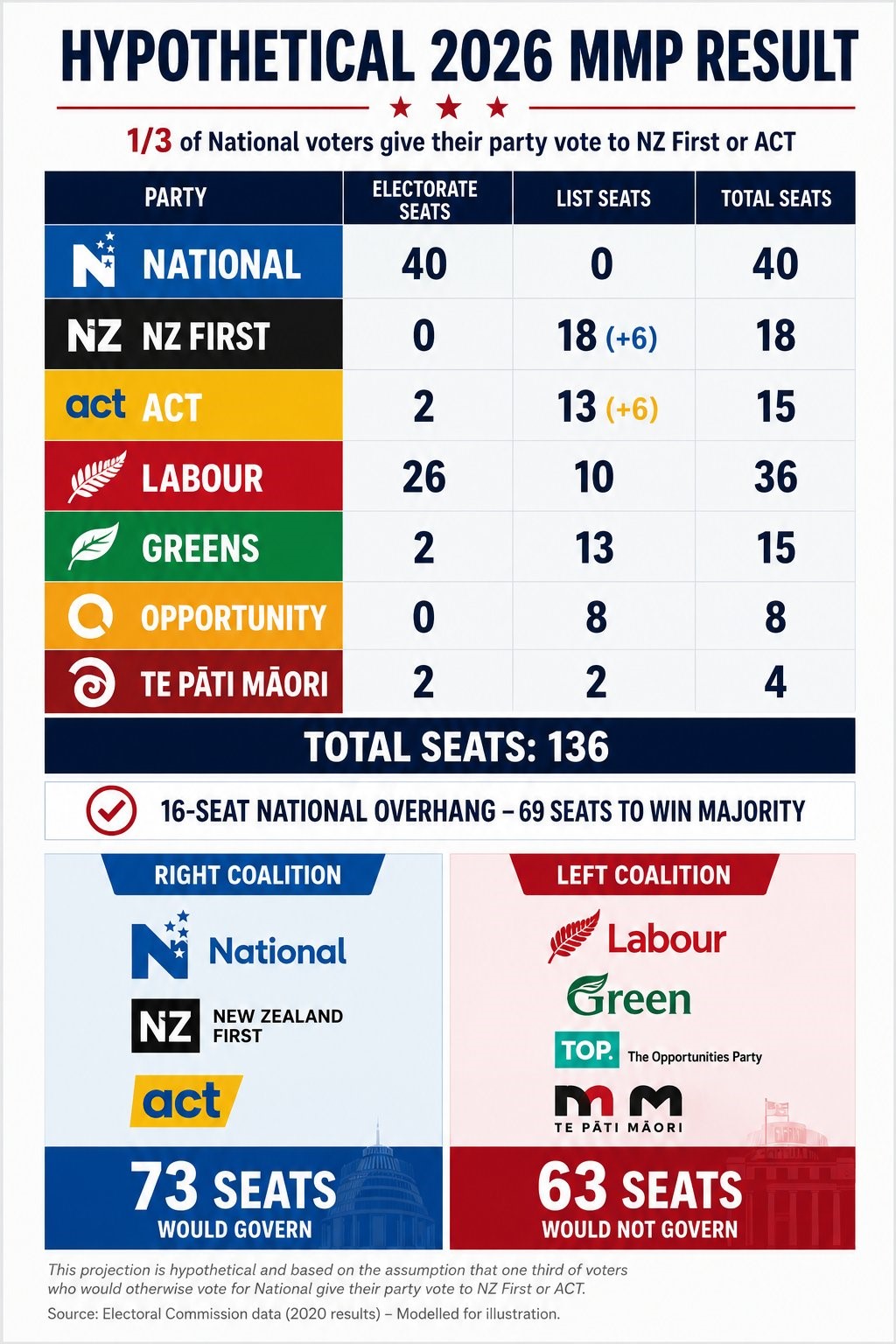
With a tight race this year, some on both sides are advocating party-vote maximisation strategies. This can create overhangs and shift coalition maths. It is interesting for National and Māori Party voters, where polling suggests potential electorate wins could exceed what might be allocated under the party vote.
Here’s a hypothetical look at how MMP could shift if a portion of National voters redirected their party vote:
Whatever side of the political divide you’re reading from, I ask you to keep one thing in mind: wealth is generated by businesses and individuals.
The more we can incentivise them, the wealthier a country we’ll have.
Regards,
Simon Angelo
Editor, Wealth Morning
(This article is the author’s personal opinion and commentary only. It is general in nature and should not be construed as any financial or investment advice. Please contact a licensed Financial Advice Provider to discuss your personal situation. Wealth Morning offers Managed Account Services for Wholesale or Eligible investors as defined in the Financial Markets Conduct Act 2013.)
Simon is the Chief Executive Officer and Publisher at Wealth Morning. He has been investing in the markets since he was 17. He recently spent a couple of years working in the hedge-fund industry in Europe. Before this, he owned an award-winning professional-services business and online-learning company in Auckland for 20 years. He has completed the Certificate in Discretionary Investment Management from the Personal Finance Society (UK), has written a bestselling book, and manages global share portfolios.