
There’s been a sad story across much of the developed world this past decade.
A woeful shortage of affordable homes for the next generation.
This has been most pronounced in New Zealand, Australia, and Canada.
How did we get here?
- People are living longer and staying in their homes longer, reducing turnover and locking up existing stock.
- Ageing populations have driven higher immigration, lifting housing demand. At times, migration surges have overwhelmed supply.
- Zoning restrictions have locked up vast areas of land, while infrastructure bottlenecks prevent new subdivisions from establishing.
- Planning bureaucracy, difficult consenting processes, and rising construction costs — worsened by supply-chain disruptions — have further strangled supply.
- Urban planning ideology favours intensification, while families prefer detached homes — creating a market mismatch.
- After the 2008 Global Financial Crisis, tighter credit caused a deep pullback in building that has yet to return to pre-GFC levels.
In the United States, White House economists estimate a shortage of 10 million homes.
They point out that this would not have occurred if ‘homebuilding and the growth of the single-family housing stock had continued at their historical pace instead of falling dramatically’ after the GFC.
Despite this shortage, America’s strong economic growth has meant disposable incomes have broadly kept pace with home prices.
New Zealand and others have not been so fortunate:
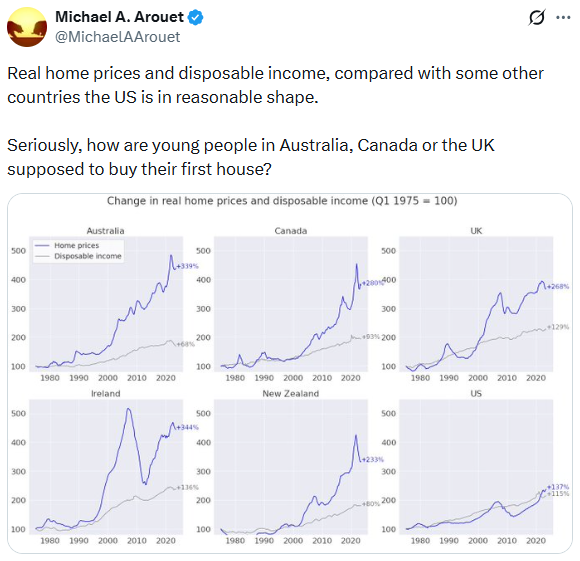
Source: Michael A. Arouet / X
When markets are allowed to function, supply responds
Now, in a functioning economy — not strangled by bureaucracy — the market should respond to deliver the homes people need. That competition drives innovation, scale, and ultimately more competitive pricing.
Well, the Trump administration is looking to move on a few fronts to open up more homebuilding:
- Reducing regulatory costs that add an estimated US$100,000 to the price of a typical home.
- Linking federal funding for states and local governments to progress on reducing regulatory barriers.
- Revisiting energy efficiency standards introduced in the previous administration.
- Opening additional federal land for residential development.
- Expanding liquidity for small single-family home builders through Federal Home Loan Bank programmes.
Analysts estimate that cutting regulatory costs alone could spur construction of up to 13.2 million homes. This could add 1.3% to annual economic growth over the next decade and support 2 million construction jobs.
Why this matters for Kiwi investors
I don’t see such measures being embraced in New Zealand in any meaningful way. It remains very difficult to procure land and gain consent, let alone the cost of building. Intensification into smaller townhouses is no panacea for enabling the family formation this country needs.
So we’re not investing in housing in New Zealand. My strategy as an investor has always been to look overseas when this market becomes too small or constricted.
This opportunity in the US presents a very attractive option. It seems the market could be readying to respond to the housing shortage. When interest rates fall, this could lead to a building boom.
Your first Quantum Wealth Report is waiting for you:
⚡🌎 Start Your Subscription: NZ$37.00 / monthly
⚡🌎 Start Your Subscription: US$24.00 / monthly



Simon is the Chief Executive Officer and Publisher at Wealth Morning. He has been investing in the markets since he was 17. He recently spent a couple of years working in the hedge-fund industry in Europe. Before this, he owned an award-winning professional-services business and online-learning company in Auckland for 20 years. He has completed the Certificate in Discretionary Investment Management from the Personal Finance Society (UK), has written a bestselling book, and manages global share portfolios.