
Do you remember where you were in 1991?
Well, I certainly do.
Back then, I was a kid living in Malaysia, and my eyes were glued to the evening news. The Gulf War was heating up. Operation Desert Storm was underway.
I was watching footage that looked like it came straight out of a video game. Precision-guided American munitions were streaking through the sky, zeroing in on Iraqi targets on the ground with eerie accuracy.
The media was calling them ‘smart bombs’.
I remember one scene vividly. The camera was mounted right on the nose of the missile itself, offering a first-person view. As it descended, swooping down, I could see an enemy tank getting closer and closer. Bigger and bigger.
Then the image disappeared, cutting to static.
A perfect surgical strike.
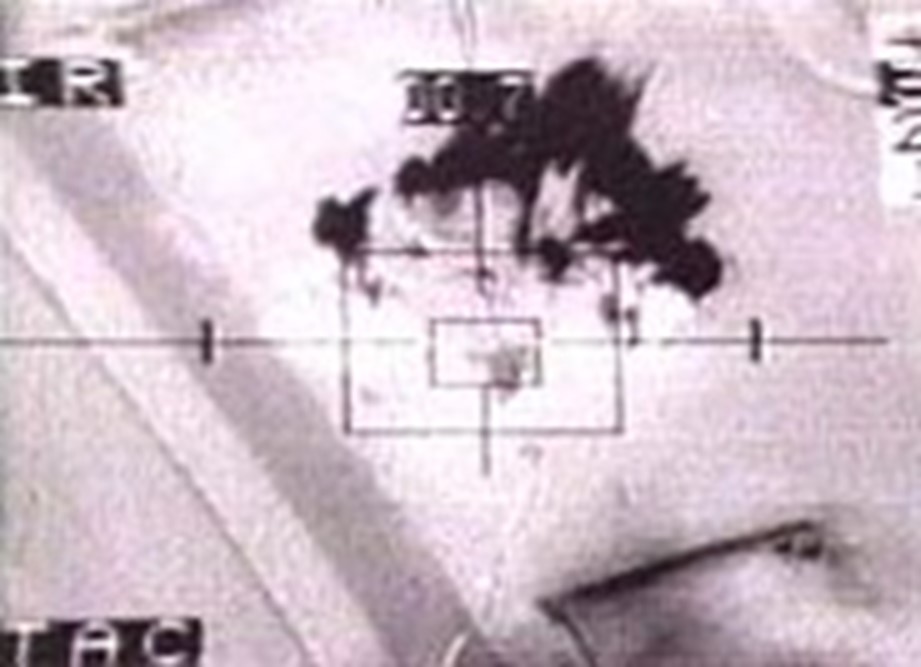
An example of a missile targeting camera. Source: CNN / Wikimedia Commons
This was strangely hypnotic to watch. And, yes, undeniably cinematic.
- You see, I’d grown up on stories of my grandfather’s rural life, surviving the Japanese occupation of British Malaya during World War II.
- But watching this new footage from the Persian Gulf was something else entirely. It offered a clean break from the past. Reinforcing something powerful in my young mind: this was the next generation of warfare. The American military juggernaut wasn’t just strong. It felt invincible. Space age.
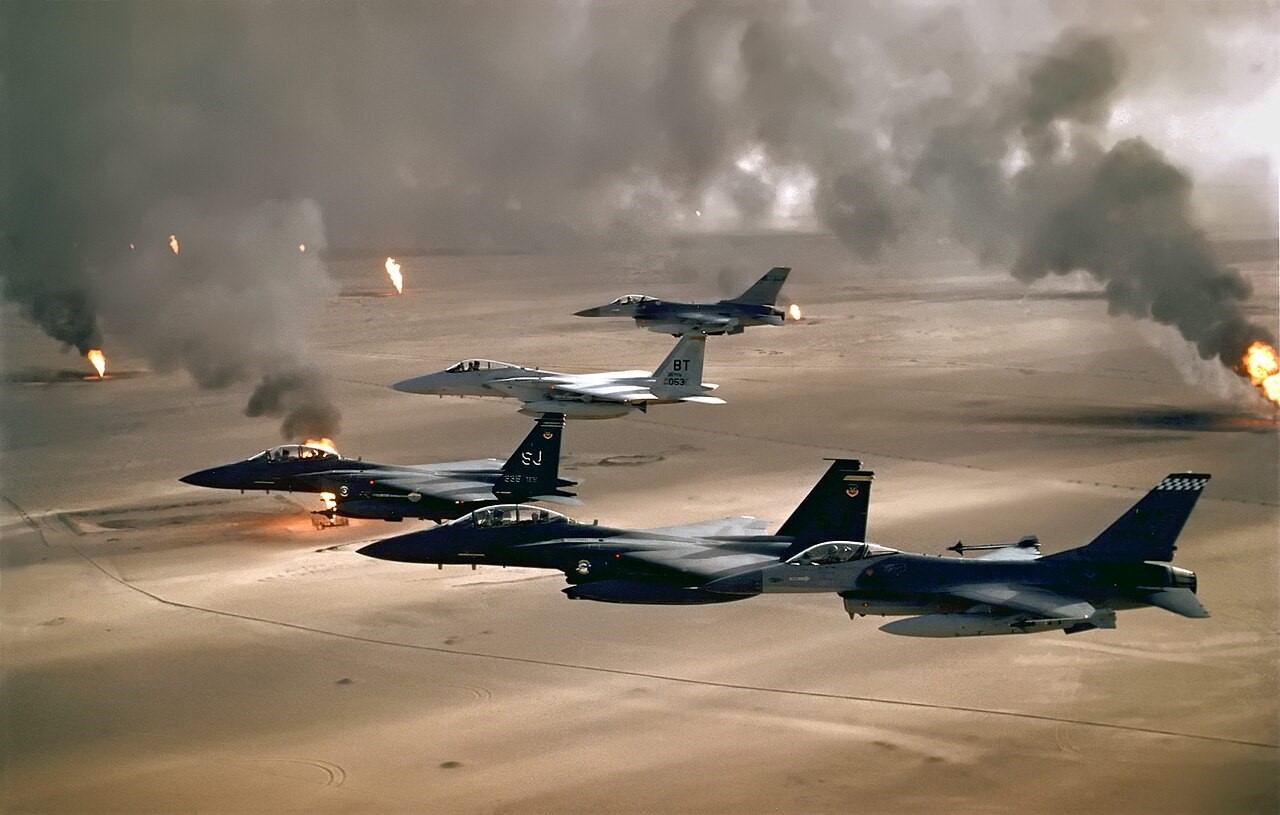
American air supremacy over Kuwait. Source: US Air Force / Wikimedia Commons
What I was seeing unfold on primetime television was extraordinary. The first part of Desert Storm was an aerial bombing campaign, which ran for 38 days. Then the second part was a ground assault, which only lasted 100 hours.
- As American-led forces pushed north, the Iraqi troops retreated in a panic. They fled along what became known as the Highway of Death. The 60 km stretch between Kuwait City and Basra became something of a turkey shoot, littered with bombed-out vehicles and smouldering corpses.
- The optics of this event were stunning. The Americans had turned this war into a textbook rout. The Iraqis were smashed. The Kuwaitis were liberated. Victory felt decisive.
- Here’s what I find astonishing: more American soldiers actually died from accidents rather than enemy fire. The records show 235 non-hostile deaths and 147 hostile deaths.
- That’s quite a disparity, isn’t it? This alone tells you just how lopsided the battlespace was. The United States had annihilated the opposition, without suffering much in return.
So, given the positive momentum, President George H. W. Bush was tempted to push all the way to Baghdad. Topple Saddam Hussein. Indeed, regime change appeared to be a possibility.
- But Bush was cautious. He understood the risks that came with mission creep. He didn’t want to stumble into a quagmire. An occupation with unknown costs. So he decided to exercise common sense. He quit while he was ahead.
- Bush declared: ‘It’s a proud day for America. And, by God, we’ve kicked the Vietnam syndrome once and for all.’
- It’s not hard to understand his feelings of vindication. He had helped engineer a war that looked fast and limited. The exact opposite of America’s trauma in Southeast Asia.
Bush hoped that the success of the Gulf War would help him in the upcoming presidential election, where he was gunning for a second term. The poll numbers seemed to stack up.
- Before the war, Bush’s approval rating was in the low 60s. Then, during the war, it soared into the 80s. Finally, it peaked at 89% in March 1991.
- Unfortunately, Bush’s military triumph didn’t translate into actual political success. By November 1992, the mood of the American public had grown sour. People were fixated on domestic worries linked to a recession. The price of fuel. The price of groceries. The availability of jobs.
- Bill Clinton would seize on these concerns to oust Bush from the White House. James Carville, Clinton’s adviser, made an observation: ‘It’s the economy, stupid.’
So let’s flash forward to the present day. Right here. Right now. March 2026.
- At the moment, we’re experiencing Operation Epic Fury, America’s military campaign against the Iranian regime. And guess what? Once again, economic concerns are front and centre.
- You can’t escape it. The cost of living dominates the conversation at every family gathering. It all eventually circles back to one simple question: ‘How much are you paying at the pump this week?’
- Also, US midterm elections are looming in November, which always amplifies emotions.
Of course, it’s tempting to draw a direct parallel between Bush’s war in 1991 and Trump’s war in 2026. Broadly speaking, the similarity is there. Both conflicts feature quick Persian Gulf campaigns driven by air power.
- However, there are important differences to consider. The geopolitical chessboard has changed. The energy landscape has shifted. And the technology of war has evolved from smart bombs to autonomous intelligence.
- For courageous and resilient investors, I think the real story isn’t in the headlines. It’s actually happening in this oil trend I’m watching right now, brewing right under the surface…
Your first Quantum Wealth Report is waiting for you:
⚡🌎 Start Your Subscription: NZ$37.00 / monthly
⚡🌎 Start Your Subscription: US$24.00 / monthly





John is the Chief Investment Officer at Wealth Morning. His responsibilities include trading, client service, and compliance. He is an experienced investor and portfolio manager, trading both on his own account and assisting with high net-worth clients. In addition to contributing financial and geopolitical articles to this site, John is a bestselling author in his own right. His international thrillers have appeared on the USA Today and Amazon bestseller lists.