
There are moments when the world shifts — suddenly, decisively.
Some threats are so dangerous that they must be confronted before they become unstoppable. Iran obtaining a nuclear weapon is one of those risks.
Since last weekend, reports emerged of a major American-Israeli military operation:
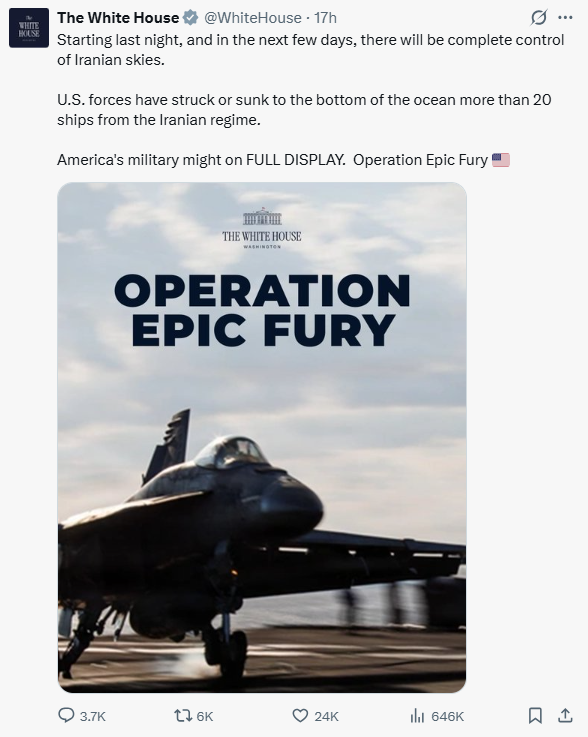
Source: The White House / X
Across all reporting, consistent themes of what the operation has achieved to date encompass:
1) Top‑tier leadership eliminated.
2) Missile, drone, air‑defence and naval forces crippled.
3) Airspace and battlespace dominance achieved by US–Israel.
4) Command, control, and military infrastructure severely disrupted.
5) Nuclear, industrial, economic, and cyber systems degraded.
If these reports are correct — Iran’s strategic military capacity has been shattered at speed, though its ability to retaliate asymmetrically (for example via drones) may remain.
Markets react: fear first, fundamentals later
When trading opened last Monday, we saw some deep single-day falls. Our European positions dropped from around 1% to as much as 5%. We were insulated by our oil holdings, which surged as much as 7%.
Interestingly, American indexes held up better in the early days. The focus quickly shifted to the oil price — the global pressure valve for geopolitical stress.
Is this a buying opportunity?
Periods of sudden uncertainty often create mispricing. In today’s high liquidity market, dislocations of this scale are rare. The key question for investors is whether the sell‑off has been overdone.
Most companies we invest in do not face direct operational risk from this conflict. The real exposure is indirect — through the oil-price risk premium. Higher fuel costs can pressure tenants of industrial warehouses in Australia or the UK, for example. Inflation concerns re-emerge. Interest rate cuts that markets had been anticipating may be delayed. Global trade flows could face disruption.
Many will remember the oil shocks of the 1970s, carless days, and the grinding years of stagflation. Those memories linger.
The petrol panic
Last weekend, a relative urged me to fill the tank before ‘gas goes through the roof’.
Once again, fear spreads faster than fundamentals.
After a meeting, I queued at Tasman Epsom and filled diesel at $1.49 per litre — a record low, surprisingly. (Tasman, a relative newcomer, is majority‑owned by a Singapore holding company and operates as a wholesaler in the New Zealand market.)
Perhaps the business shrewdly used the opportunity to capture volume and new customers?
As I write, the same filling station is now selling diesel at $1.74 (up 16.8%).
Either way, for all the headlines and fear, extreme oil-price risk premium has yet to reach New Zealand.
It might take a severe disruption to see a 30% jump. There’s already nearly that much variation between full-service and self-serve kiosks.
BloombergNEF modelling suggests Brent only stays above $90 if Iran’s exports are completely removed — an extreme scenario viewed as unlikely. Though the price did hit $90 over the weekend when the UAE and Kuwait announced oil output cuts on concerns of Hormuz Strait blockage .
Why this isn’t 2012 or 2022
From 2012 to 2014, oil was more expensive (around US$100+ per barrel). China and India were consuming record amounts. Oil supply was tight. The US shale boom had yet to flood the market. The price also saw geopolitical risk premium around Iran sanctions and nuclear tensions.
Then in 2022, oil supply was still ramping up following the pandemic. That’s when Russia commenced a full-scale invasion of Ukraine. Brent crude briefly exceeded $110:
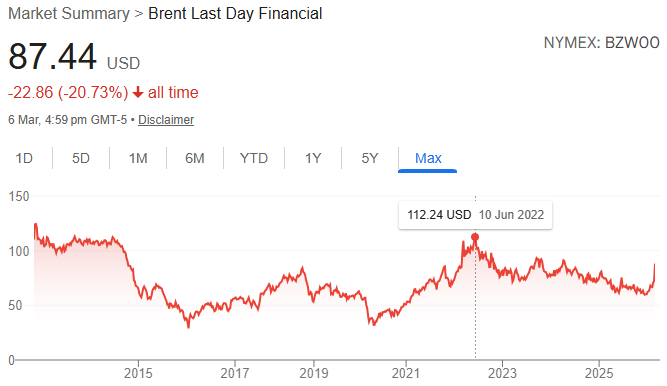
Source: Google Finance
Today, the oil price outlook is much more nuanced:
- The United States now produces more crude than it consumes.
- OPEC has signalled willingness to increase supply.
- China’s economic slowdown is dampening demand.
Taken together, the risk premium from this conflict may be smaller than some of the panic we’re hearing. Volatility is likely, but much further price spike is not inevitable.
Of course, New Zealand’s lack of refining capacity does make us more vulnerable to supply disruptions. Our only option is to import refined fuels.
Why we’ve been adding to positions
Markets have a deep aversion to uncertainty. They tend to overshoot on fear. Successful long-term investors learn to look through that fog. Uncertainty is always present — it simply becomes more visible at times like this.
If the early reports of military effectiveness prove accurate, the long-run risk of nuclear catastrophe in the Middle East has likely diminished massively. Of course, we could also see prolonged instability. Both outcomes remain possible. But the market reaction so far appears to price in a worst-case scenario.
My view is the world — and our global assets — could end up safer than before.
Of course, that is not to say that escalation won’t see more volatility.
A moment of consequence
We do not yet know how events will unfold. Many attempts were reportedly made to negotiate a peaceful solution.
If this moment ultimately reduces long-term nuclear risk and stabilises the region, the implications could be profound.
Oil supply is not as strained as it was in 2012 or 2022. Even through the fog of uncertainty, progress has a way of reasserting itself.
Certainly, if Operation Fury achieves its mission, winds down, and Hormuz traffic normalises, the risk premium will evaporate fast. Markets could rally.
Freedom for Iran may be closer than at any point since 1979.
A Golden Age is coming. Driven by innovation, energy abundance, and the resilience that emerges from moments like this.
Regards,
Simon Angelo
Editor, Wealth Morning
(This article is the author’s personal opinion and commentary only. It is general in nature and should not be construed as any financial or investment advice. Please contact a licensed Financial Advice Provider to discuss your personal situation. Wealth Morning offers Managed Account Services for Wholesale or Eligible investors as defined in the Financial Markets Conduct Act 2013.)
Simon is the Chief Executive Officer and Publisher at Wealth Morning. He has been investing in the markets since he was 17. He recently spent a couple of years working in the hedge-fund industry in Europe. Before this, he owned an award-winning professional-services business and online-learning company in Auckland for 20 years. He has completed the Certificate in Discretionary Investment Management from the Personal Finance Society (UK), has written a bestselling book, and manages global share portfolios.