
A good bet in economics: the past wasn’t as good as you remember,
the present isn’t as bad as you think,
and the future will be better than you anticipate.
―Morgan Housel
Let me ask you a question.
Are you a person who believes that the glass is half-full?
Or…are you a person who believes that the glass is half-empty?

Source: Image by Joel from Pixabay
Of course, the gap between optimism and pessimism has been a matter of philosophical debate over the centuries.
- For me, I find it fascinating to observe that some folks have an eternally sunny outlook when it comes to life, even while others appear to be perpetually gloomy.
- Does this happen because of nature? Are people born with a certain attitude that determines their destiny?
- Or…does nurture play a bigger role? Does upbringing and education actively shape how people turn out to be?
- Or…is it simply a matter of cognitive bias? Are people choosing to see only what they want to see? Because of mental prejudice?
Well, for the sake of argument, let’s assume that cognitive bias plays the key role in shaping human perceptions. Let me give you a real example of why it matters so much:
- Since 1987, the Conference Board in the United States has run a questionnaire known as the Consumer Confidence Survey.
- This national survey is done monthly. It measures people’s feelings on a wide range of issues. Everything from grocery prices to vacation plans to job happiness. You name it, the survey explores it. Extensively.
- Now, here’s the intriguing thing: in almost four decades of data, what you will find is that a majority of Americans — around 64% on average — usually thought that the stock market would either remain flat or drop in the 12 months ahead.
- In fact, according to analyst Callie Cox, there were only six months where a majority of the people actually felt positive about the stock market’s progress.
- That’s stunning when you think about it. In almost four decades of survey data, there were only six months of optimism!
But guess what? People’s feelings on this were totally wrong.
- Between 1987 and 2024, the S&P 500 delivered a nominal return of over 2,300%. And if you choose to add reinvested dividends, that return is even stronger. It soars to over 5,200%.
- It’s astonishing, isn’t it? The market kept growing at a steady pace — even when most Americans did not believe that the immediate future would be positive.
- Indeed, the gap between a pessimistic mindset and an optimistic outcome is huge. Insanely huge.
- Mind you, this is by no means an isolated incident. Human beings have always had this long-standing habit of being pessimistic and misreading the cycle of history.
Source: Morningstar
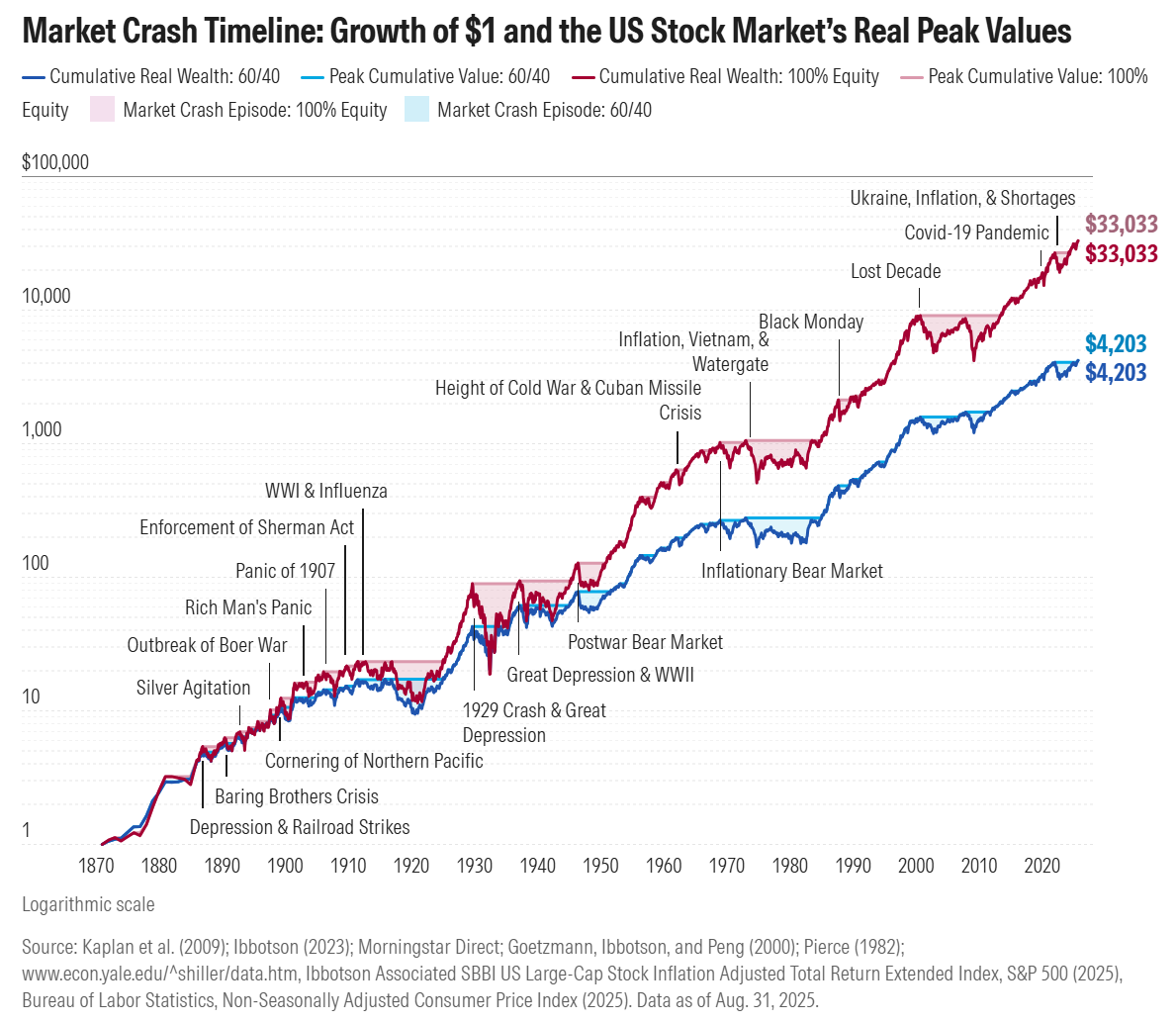
Let me give you an example of this. Research firm Morningstar recently did a stress test on 155 years of American investment history. Here’s what they uncovered:
- A nominal sum of $1 that was invested 100% into the stock market in December 1870 would have mushroomed into $33,033 by August 2025. This is adjusted for inflation.
- Therefore, you’re getting real growth of over 3,300,000%. This is a stunning result.
- Indeed, despite all the wars, all the recessions, all the pandemics — the market just kept chugging along like a unstoppable locomotive, climbing that wall of worry.
What I find most interesting, though, is how the 60/40 portfolio (60% stocks and 40% bonds) performed over that same time period.
- This combination delivered a final return of $4,203. That’s real growth of over 420,000%. This is respectable, yes — but the performance of the 60/40 portfolio falls well short compared to being 100% invested in stocks.
- This suggests that the presence of bonds in a portfolio can cushion an investor from the shocks that come from fear events in the short-term — but they may actually act as a drag on compounded returns in the long-term.
- In other words, optimism eventually wins out over pessimism. Yes, the market can be volatile. Yes, it can be prone to wild price swings. But what an investor gets in return for enduring this volatility and staying the course is a risk premium (hazard pay) that’s second to none.
Source: Peter Mallouk / X
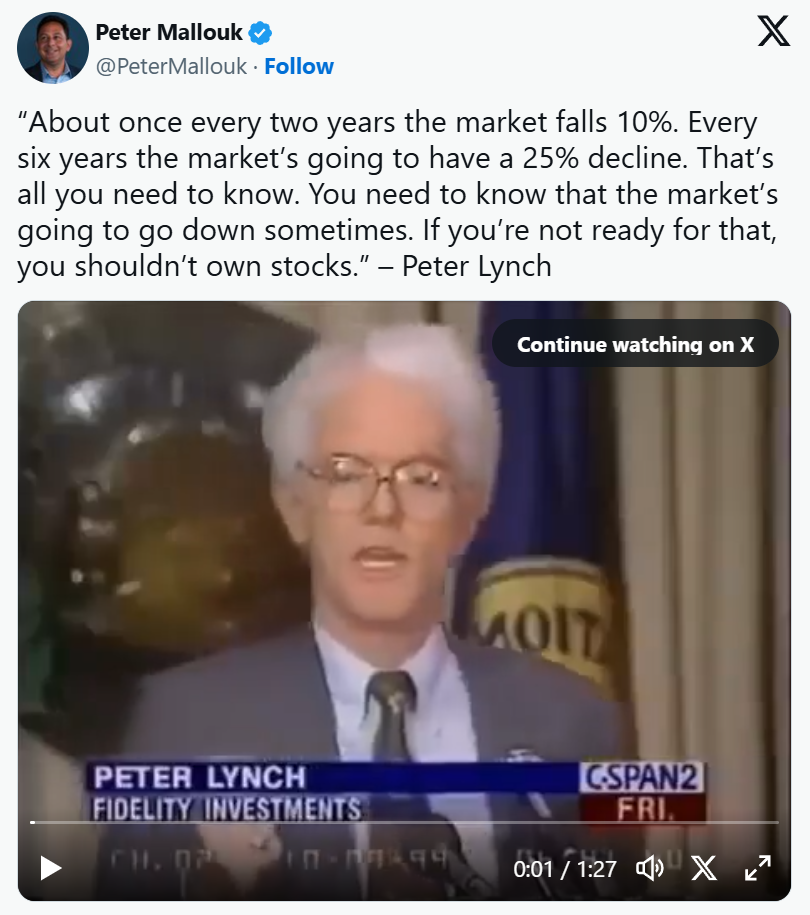
Peter Lynch, a famous value investor with an optimistic outlook, has acknowledged that sudden shifts in the market can cause anxiety. Many people are naturally afraid of corrections. They dread them. They do everything to avoid them.
- Still, Lynch has said: ‘Far more money has been lost by investors trying to anticipate corrections, than lost in the corrections themselves.’
- Indeed, despite the pain and grief that a correction might inflict in the short-term, the evidence appears to suggest that it pays to stay invested for the long-term.
- Of course, past performance is no guarantee of the future. It never is.
- Nevertheless, I’m willing to bet that the optimistic investors will push forward anyway. They will keep reaching for that risk premium. Because it’s helpful to believe that the glass is half-full, not half-empty.
It’s time to have your say
I hope that you’ve enjoyed reading our articles as much as we’ve enjoyed writing them:
- Your prosperity is our focus — which is why we are always working hard to uncover new opportunities beyond the radar for you.
By the way, I have a small favour to ask:
- Would you like to write a review of our work here at Wealth Morning?
- Do you want to let us know if our stories have inspired you in a positive way?
- Do you want to let us know if our stories have helped you become a more successful investor?
We truly value your feedback. It encourages us. It helps us to do better. It helps us to reach further:
- So, if you’d like to leave us a review, it’s quick and easy. It will only take two minutes of your time.
- Thank you so much in advance for your kindness and generosity. Your readership keeps us going!
Regards,
John Ling
Analyst, Wealth Morning
(This article is the author’s personal opinion and commentary only. It is general in nature and should not be construed as any financial or investment advice. Wealth Morning offers Managed Account Services for Wholesale or Eligible investors as defined in the Financial Markets Conduct Act 2013.)
John is the Chief Investment Officer at Wealth Morning. His responsibilities include trading, client service, and compliance. He is an experienced investor and portfolio manager, trading both on his own account and assisting with high net-worth clients. In addition to contributing financial and geopolitical articles to this site, John is a bestselling author in his own right. His international thrillers have appeared on the USA Today and Amazon bestseller lists.