
Sometime in the 1940s, Abraham Maslow drew a triangle.
At the bottom, he put food, shelter, safety. At the top, self-actualisation — the fully realised self.
His argument was simple enough: once the basics are settled, human beings start reaching for something higher. What he did not foresee was how completely business would learn to sell that reaching.
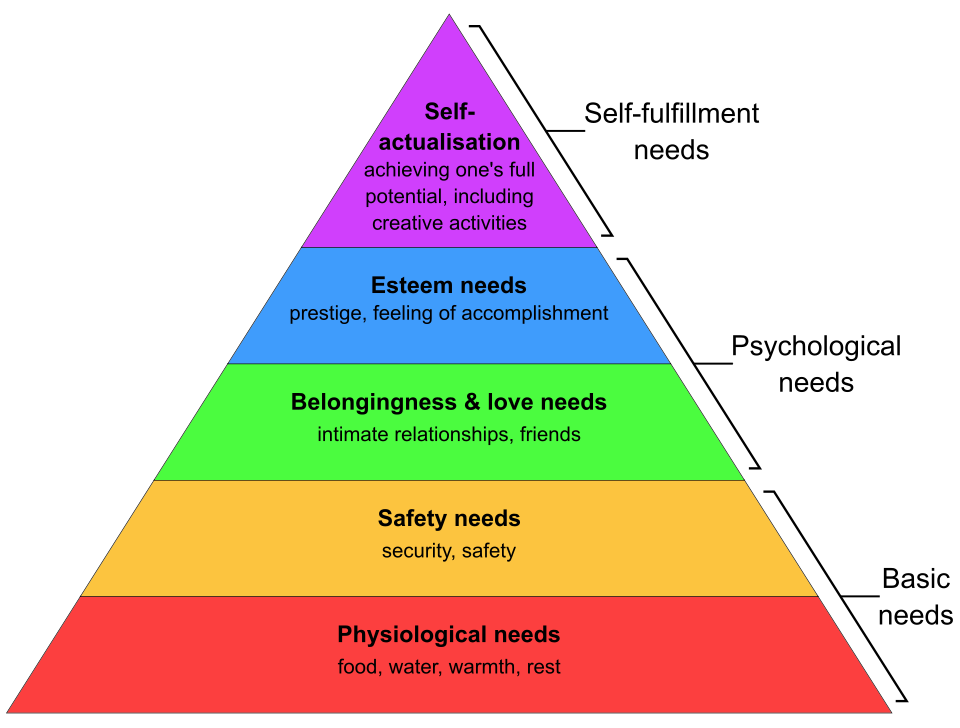
Source: Androidmarsexpress / Wikimedia Commons
Think about what has changed in just two generations.
In 1960, a family in Mumbai or Manchester or Ohio bought clothes to cover the body. You bought, you wore, you replaced when it tore.
Today, that same category has split into a dozen different markets, and hardly any of them are about covering anything at all. Athleisure sells identity. Fast fashion sells novelty. And sitting quietly in the middle is a category that would have completely puzzled a shopper of that era — sleepwear as a gift, as personality, as something you buy for someone to show that you know them.
Nobody needs a $90 pair of pyjamas. That is exactly the point. The market for what people need is a race to the bottom — everybody knows the price, everybody undercuts, the margin disappears.
The market for what people want to be is where the money has always been. And the last 50 years of rising prosperity have done something quite extraordinary. They have pushed hundreds of millions of people far enough up Maslow’s triangle that aspiration is no longer a luxury business. It is a mass-market one.
This is the engine running quietly behind a whole class of companies. Not the ones selling necessities, but the ones that took something ordinary and repositioned it as emotional. A candle is wax and thread. A greeting card is folded paper. A pencil case is a zip and some cloth. Put the right brand on each one and you get a gross margin that would be laughable in the category it technically belongs to.
For an investor, the question is not whether this works. It clearly does. The real question is how long it lasts. Emotional positioning is wonderfully profitable and nearly impossible to copy. But it is fragile in one very particular way — it depends entirely on the customer still believing the story. And it survives only if the people running the business remember that they are not really in the pyjama trade.
Which brings me to this company on the ASX that has spent 30 years proving that both halves of that argument — profit and fragility — exist inside the same portfolio…
Your first Quantum Wealth Report is waiting for you:
⚡🌎 Start Your Subscription: NZ$37.00 / monthly
⚡🌎 Start Your Subscription: US$24.00 / monthly




Amit is an analyst and writer at Wealth Morning. He is deeply passionate about understanding how businesses create value, and he brings strong financial modelling skills to his research. Amit has 10+ years of experience across firms like State Street, AMP Capital, and Sydney Water, where he has done analysis on institutional investments ranging from $10 million to $3 billion. He focuses on what matters most: strategic asset allocation and long-term performance. Amit holds a Master of Business Administration in finance from the University of Wollongong. With an intelligent approach to downside protection, he offers a contrarian perspective on global investment strategy.