
‘Our approach is very much profiting from lack of change rather than from change.
With Wrigley chewing gum, it’s the lack of change that appeals to me.
I don’t think it is going to be hurt by the Internet. That’s the kind of business I like.’—Warren Buffett
Every conversation in markets right now runs through the same two letters. AI is the reason for every rally, every capex announcement, every stretched multiple. And the expectations now baked into these companies are almost impossible to meet.
I’m not making the case that artificial intelligence is a fraud. It isn’t. Genuinely transformative businesses will come out of this — probably ones nobody has heard of yet. That’s how it usually goes. What I’m saying is that the room is very loud, and the loudest room is rarely where the good prices are.
I spent time in Seattle in 2023, and it left an impression I still haven’t shaken.
America runs on a kind of raw meritocracy — hyper-competitive, unforgiving, and extraordinarily good at rewarding output. It’s the engine that has produced decades of technological leadership, and you can feel it in a city like Seattle. You can also see what it costs. The gap between people doing very well and people doing very badly was there on the street, block by block.
I’m not going to pretend I can explain systemic poverty from a week of walking around. But it did sharpen something for me. A system that rewards innovation this ruthlessly will chase whatever is hottest with everything it has. And when all that capital, talent, and attention crowd into one sector, they necessarily drains out of somewhere else.
That somewhere else is where I want to be.


View from the Space Needle in Seattle. Source: Author
While everyone else is studying GPU supply chains, I’ve been reading about Consumer Staples.
What is interesting is that while the broad S&P 500 is trading at a P/E of around 28x, Consumer Staples has a P/E of around 21x.
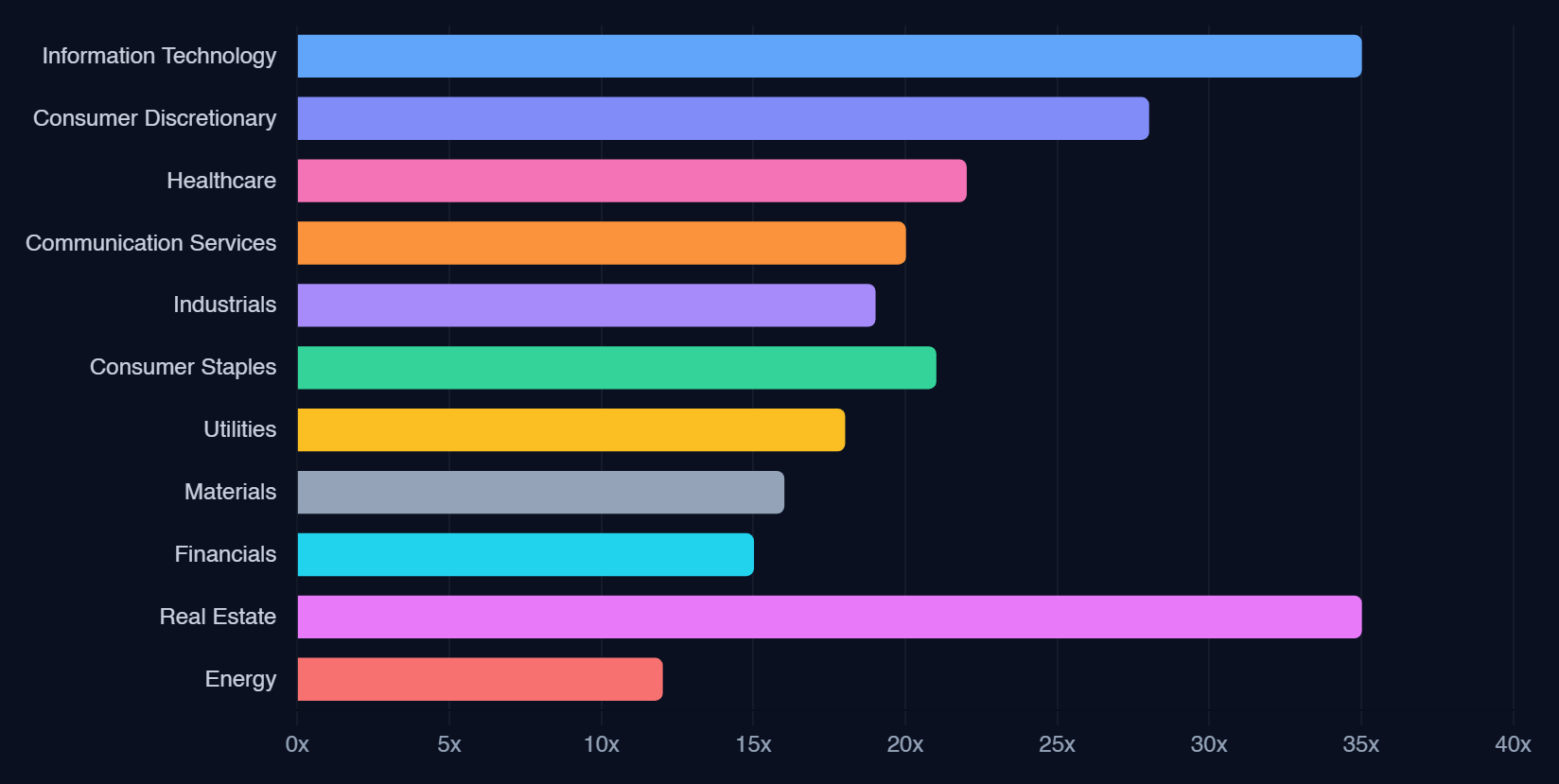

Source: Westmount Fundamentals
I dug deep and found one such company has been around for 130 years.
Think about what that means. A century-old food business has already survived two world wars, the Depression, oil shocks, inflation, deflation, pandemics, and every shift in how people eat.
It didn’t need to reinvent itself every six months. It just had to keep meeting a need that doesn’t go away: people get hungry, three times a day, forever.
Compare that to a startup burning cash while it searches for a path to profitability.
One of these has proved it can endure. The other is asking you to believe it will.
The businesses I keep coming back to are the ones that feed communities and, almost as a by-product, return steady cash to their owners for decades. Unglamorous. Predictable. Exactly the ‘lack of change’ Buffett was talking about with Wrigley.
Buying into the AI trade is a bet on rapid change going more or less exactly as hoped. Buying heritage consumer staples is a bet on human nature and on the fact that businesses which have survived everything tend to keep surviving.
Contrarianism isn’t about being difficult for its own sake. It’s about looking where the spotlight isn’t. When the crowd is fighting over multiples that leave no room for error, the margin of safety may be somewhere else — and usually it’s in the quiet corner of the market that nobody wants to write about.
That’s the corner I plan to spend my time in. Boring businesses don’t lead the evening news. They just tend to make people wealthy…
Your first Quantum Wealth Report is waiting for you: