History has a habit of disciplining those who mistake restraint for safety.
Time and again, history has favoured not the peacemakers, but the prepared.
That is not cynicism; it is an observation grounded in how power actually behaves when left unchecked. The structures governing geopolitics reward those who anticipate conflict, not those who assume goodwill.
Few examples capture this more starkly than Neville Chamberlain’s appeasement of Hitler.
Chamberlain’s aim was honourable: to preserve peace at almost any cost. But his reluctance to prepare, to deter, or to confront early allowed Hitler to advance uncontested through Austria and Czechoslovakia. Hitler absorbed their strategic industries and military capacity before the world fully grasped the consequences.
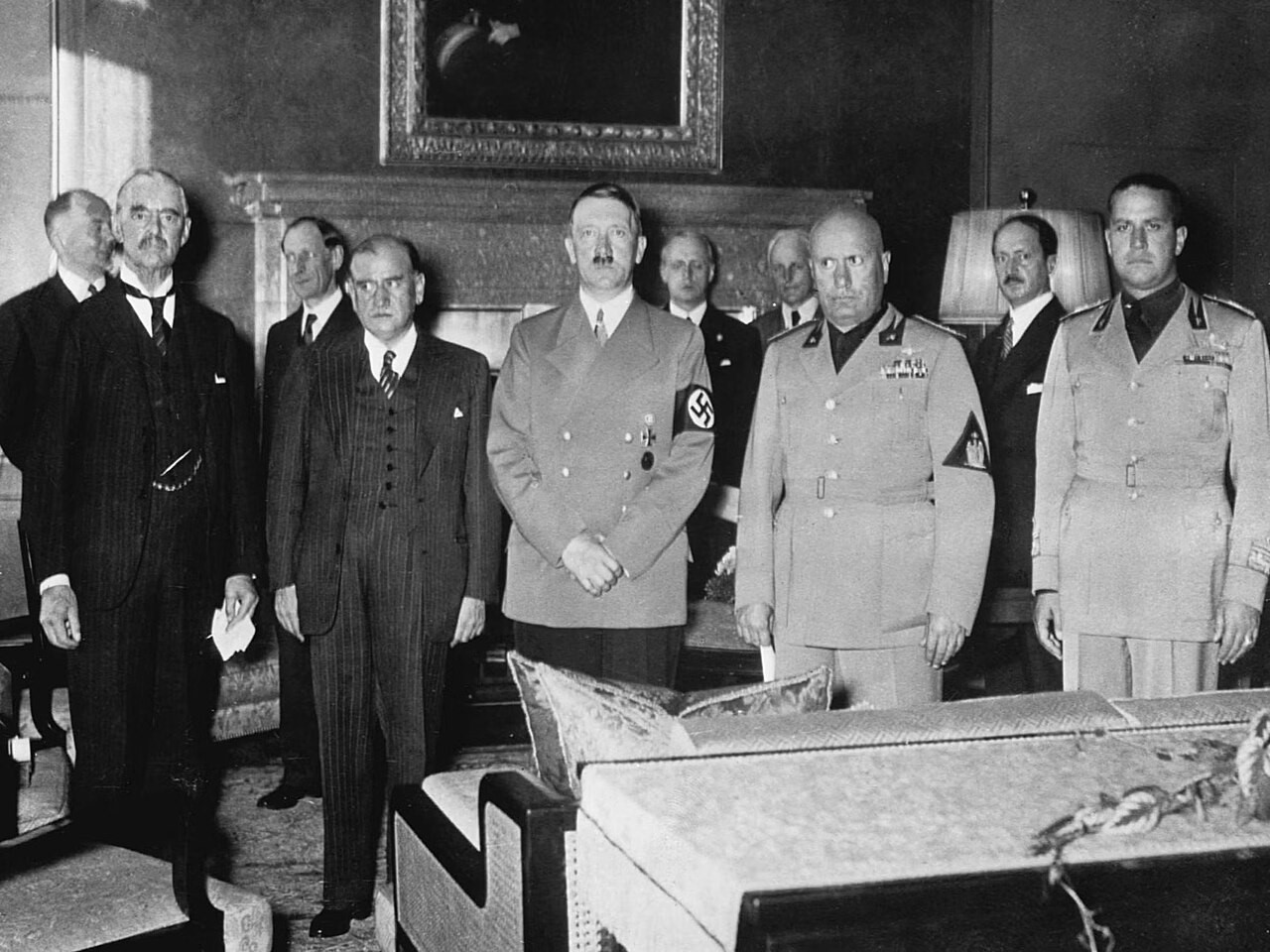

Chamberlain, Daladier, Hitler, Mussolini, and Italian foreign minister Count Galeazzo Ciano
as they prepare to sign the Munich Agreement. Source: Wikimedia Commons
By the time resolve replaced restraint, the balance of power had already shifted.
That idea — incentives overpowering ideals — is what game theory was built to explain.
Today, it has become an important framework for understanding the global defence landscape and the multi-trillion-dollar rearmament cycle underway. It’s also useful for understanding the companies positioned at the crossroads of software, sovereignty, and security.
We are entering what defence analysts call a ‘structural militarisation cycle’. Not cyclical. Structural. Once-in-a-generation. The kind of cycle that rewires budgets, industries, alliances, and technological trajectories.
At the centre of it is something much more fundamental than politics: broken trust.
How we got here: cooperation fails, defection pays
In economics textbooks, the Prisoner’s Dilemma is a common thought experiment to explain game theory. In geopolitics, it’s a budget line for each country.
Game theory tells us that when one player defects and gains an advantage, the other players, rationally, must defect as well.
This becomes far more entrenched when the game repeats itself over time in different iterations and when the cost of being wrong is existential.
The world has accumulated a shocking number of defections recently:
- Russia’s invasion of Ukraine (2022) directly violated the Budapest Memorandum, in which Ukraine surrendered the world’s third-largest nuclear arsenal.
- China’s militarisation of the South China Sea, despite assurances to the contrary in 2015.
- Iran’s acceleration of uranium enrichment after the collapse of the JCPOA nuclear agreement.
- North Korea conducting six nuclear tests despite UN sanctions.
When defections accumulate, beliefs update. And once trust collapses, cooperation becomes irrational.
Because, after all, people are much quicker to lose trust after someone’s malign actions than they are to regain trust after the other player apologises.
This is why defence spending has been surging at a pace not seen since the Cold War. We have had multiple iterations of broken trust.
The hard numbers
Global defence spending reached US$2.44 trillion in 2024, the highest level in recorded history. It’s up from approximately US$2.24 trillion in 2023.
That number isn’t abstract. It reflects a massive repricing of geopolitical risk.
Some specifics:
- In 2021, only 6 out of 32 NATO members hit the 2% of GDP defence target. By 2024, 23 countries crossed the threshold, the fastest standardisation of military expenditure ever recorded by the alliance. This figure will only grow as Trump plays his cards right and discourages NATO members from assuming continued US support.
- European defence budgets rose from €218 billion in 2021 to €343 billion in 2024, with €381 billion forecast for 2026. That is a 75% jump in four years, unprecedented in peacetime.
- Europe is attempting to triple annual artillery output from 300,000 shells per year to over 1 million. Ukraine currently fires that many every 90–120 days of high-intensity combat.
- The military drone market is estimated at US$40.5 billion in 2024, projected to reach US$87.6 billion by 2030 (CAGR 14%).
This is not noise. This is a paradigm shift.
Your first Quantum Wealth Report is waiting for you: